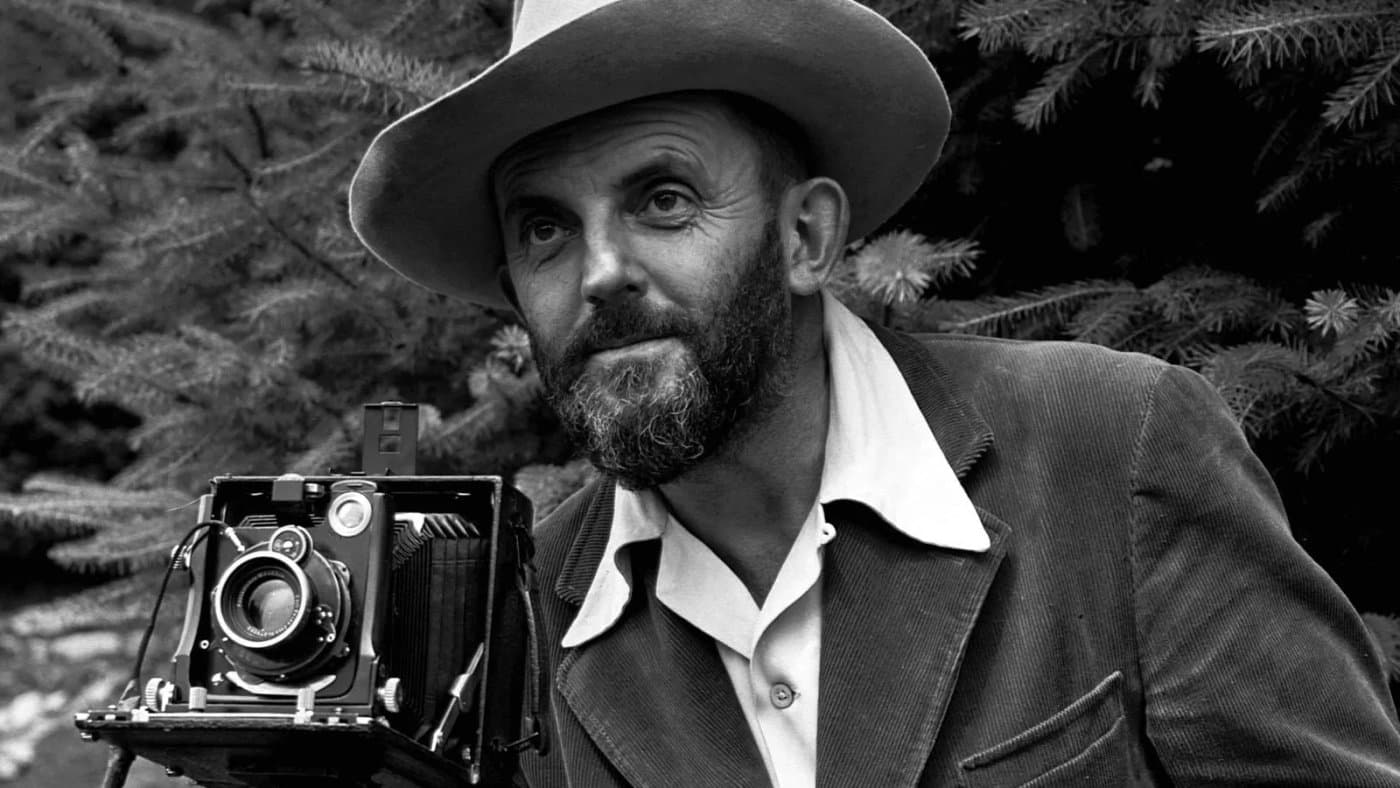
Ansel Adams: Engineering the American Sublime
Masters · 9/5/2026
How exposure calculations, darkroom control, and editorial selection built a vision of wilderness so persuasive it changed conservation law — and so selective it left out the people who lived in that land.
Ansel Adams at a glance
| Full name | Ansel Easton Adams |
| Life | February 20, 1902, San Francisco, California – April 22, 1984, Monterey, California |
| Nationality | American |
| Genres | Landscape and nature photography, conservation photography, portraiture, technical/instructional writing |
| Active | c. 1920s – 1984 |
| Places | San Francisco; Yosemite National Park; Carmel-by-the-Sea, California; the American Southwest and national parks system |
| Official / archive | anseladams.com (Ansel Adams Publishing Rights Trust / The Ansel Adams Gallery); Center for Creative Photography, University of Arizona |
| Selected distinctions | Guggenheim Fellowships (1946, 1948, 1958); Presidential Medal of Freedom (1980); Mount Ansel Adams and the Ansel Adams Wilderness named in his honor (1984–85) |
On an afternoon in 1927, standing on a ledge above Yosemite Valley with four glass plates left in his pack, Ansel Adams changed a filter, reconsidered the tonal range of a scene he had already exposed once, and made a second exposure of Half Dome that turned a bright afternoon sky into something close to midnight. He called the decision, made in the field before he had seen a negative, "visualization" — and he later built an entire teaching system, the Zone System, around formalizing that single act of technical foresight. Adams's real subject was never simply Yosemite, the Sierra Nevada, or the American wilderness as such, but the degree of control a photographer could exert over how those places would be seen — through exposure calculation, darkroom manipulation, and ruthless selection — in service of a particular, and particularly depopulated, American ideal. That control produced images of extraordinary persuasive power, images that helped establish photography as a fine art and helped save real acres of real land. It also produced a body of work whose omissions — of Indigenous history, of labor, of almost anyone at all — are as consequential as its inclusions, and whose most ethically fraught chapter, a 1943 commission at a Japanese-American incarceration camp, exposes the limits of a visual language built for grandeur rather than for injustice.
Life: A Restless Boy Who Found Yosemite
Ansel Easton Adams was born February 20, 1902, in San Francisco, the only child of Charles Hitchcock Adams, a businessman, and Olive Bray Adams. The family's comfortable circumstances were destabilized early: Charles's finances collapsed in the wake of the 1906 earthquake and subsequent economic downturns, a strain that shaped the household for years. Adams himself was marked more literally by the earthquake's aftermath — an aftershock in 1906 threw the four-year-old into a garden wall, breaking his nose and leaving it permanently crooked, a detail biographers have long treated as an emblem of a childhood defined by disruption rather than ease (Alinder, Ansel Adams: A Biography, 1996).
Adams was a poor fit for formal schooling — restless, likely dyslexic by later diagnosis, and expelled from more than one institution — and his father withdrew him from conventional education, arranging private tutors and, crucially, allowing the boy's obsessive energies to run toward the piano. Adams trained seriously as a classical pianist through his teens and into his twenties, seriously enough that he weighed music as a profession; he later credited that training with giving him the disciplined, almost notational way he thought about tonal structure in a photograph, an analogy he made explicit and literal in his own technical writing.
The turn toward photography came in 1916, when his parents took him to Yosemite National Park and gave him a Kodak Box Brownie. He returned nearly every year afterward, and in 1919 joined the Sierra Club, working several seasons as custodian of the LeConte Memorial Lodge, the club's Yosemite educational center — a job that placed him inside the organization that would shape his career's second, political axis for the rest of his life. It was in Yosemite that he met Virginia Best, daughter of the owner of Best's Studio, a small photography and art shop on the valley floor; they married in 1928, and the studio eventually became, under Adams family ownership, today's Ansel Adams Gallery.
His earliest serious work belonged to the soft-focus, tonally romantic conventions of Pictorialism, then the dominant idiom for "artistic" photography. The decisive break came in the early 1930s. Adams later described seeing Paul Strand's sharp, unmanipulated negatives in New Mexico in 1930 as pivotal in pushing him toward what the movement would call "straight photography" — full tonal range, maximum sharpness, no manipulation disguised as painterly effect. In 1932 Adams co-founded Group f/64 with Edward Weston, Imogen Cunningham, Willard Van Dyke, and others, named for the small lens aperture that produced maximum depth of field; their informal manifesto rejected Pictorialist soft-focus in favor of what they called "pure photography." Alfred Stieglitz, the most important gatekeeper in American art photography, gave Adams a solo exhibition at his New York gallery An American Place in 1936 — an endorsement that mattered enormously for a young West Coast photographer seeking legitimacy in an East Coast–dominated art world.
Method: Previsualization, the Zone System, and the Discipline of the Print
Adams's technical apparatus changed across six decades, and sources do not always agree on specifics for every period, but the broad arc is clear. He worked for most of his career with large-format view cameras — most often 8x10 and 4x5 inch formats from several manufacturers — valuing the enormous negative for its tonal resolution and the camera's movements (rise, fall, tilt, swing) for controlling perspective and focus in a landscape. He used colored filters, notably a deep red filter, to control how a blue sky translated into the black-and-white tonal scale, a technique central to the effect of his 1927 Monolith (see below). Later in life he also worked with medium-format cameras such as Hasselblad for greater portability, and he maintained a long consulting relationship with Polaroid Corporation and its founder Edwin Land beginning in 1948, testing instant films and cameras for the company almost until his death — a commercial and technical relationship rarely foregrounded in the popular image of Adams as a wilderness ascetic.
The signature achievement of his working method is the Zone System, developed with fellow photographer and teacher Fred Archer at the Art Center School in Los Angeles in the late 1930s and early 1940s. The system divided the tonal range from pure black to pure white into numbered zones and gave photographers a repeatable method for metering a scene, choosing an exposure, and calibrating film development so that a specific area of the final print — a shadowed rock face, a lit cloud — would land exactly where the photographer wanted it on the tonal scale. Adams called the underlying philosophy "previsualization": deciding, before the shutter fired, what the finished print should look like, and then engineering exposure and development backward from that decision. He formalized the idea across his instructional books, especially The Negative and The Print, and it remains a foundational teaching tool in analog photography education.
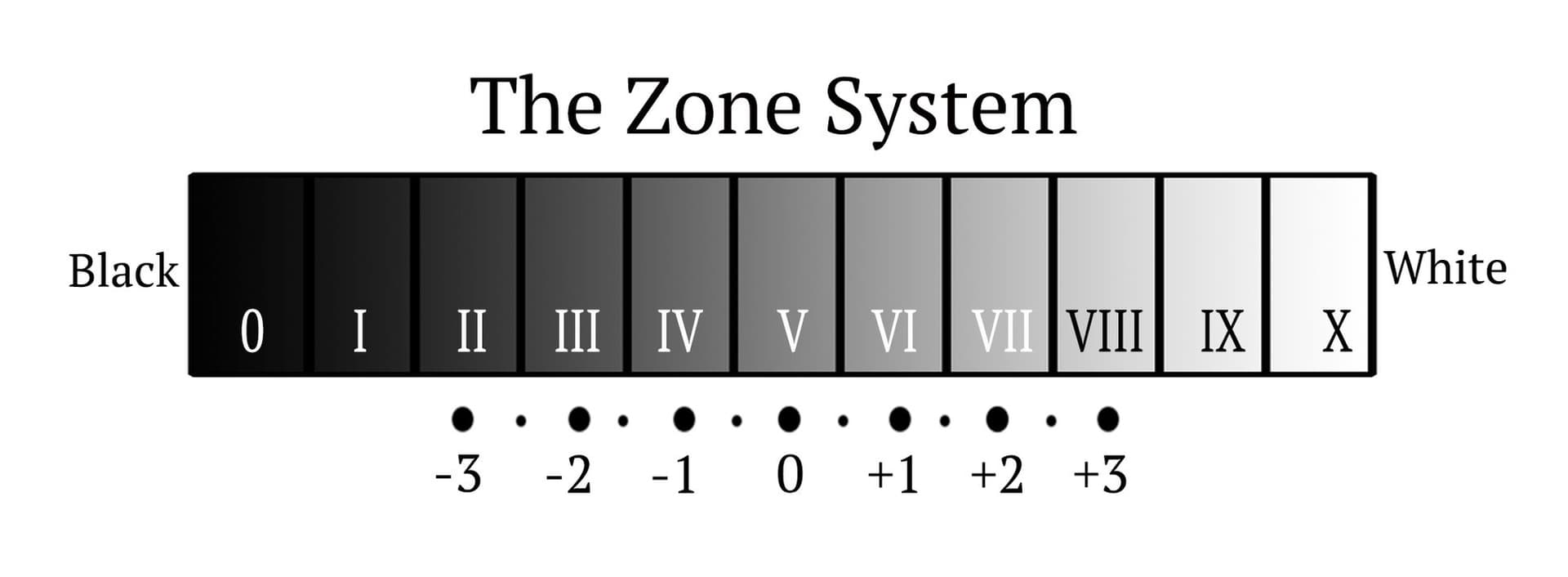 Amsel Adams Zone System
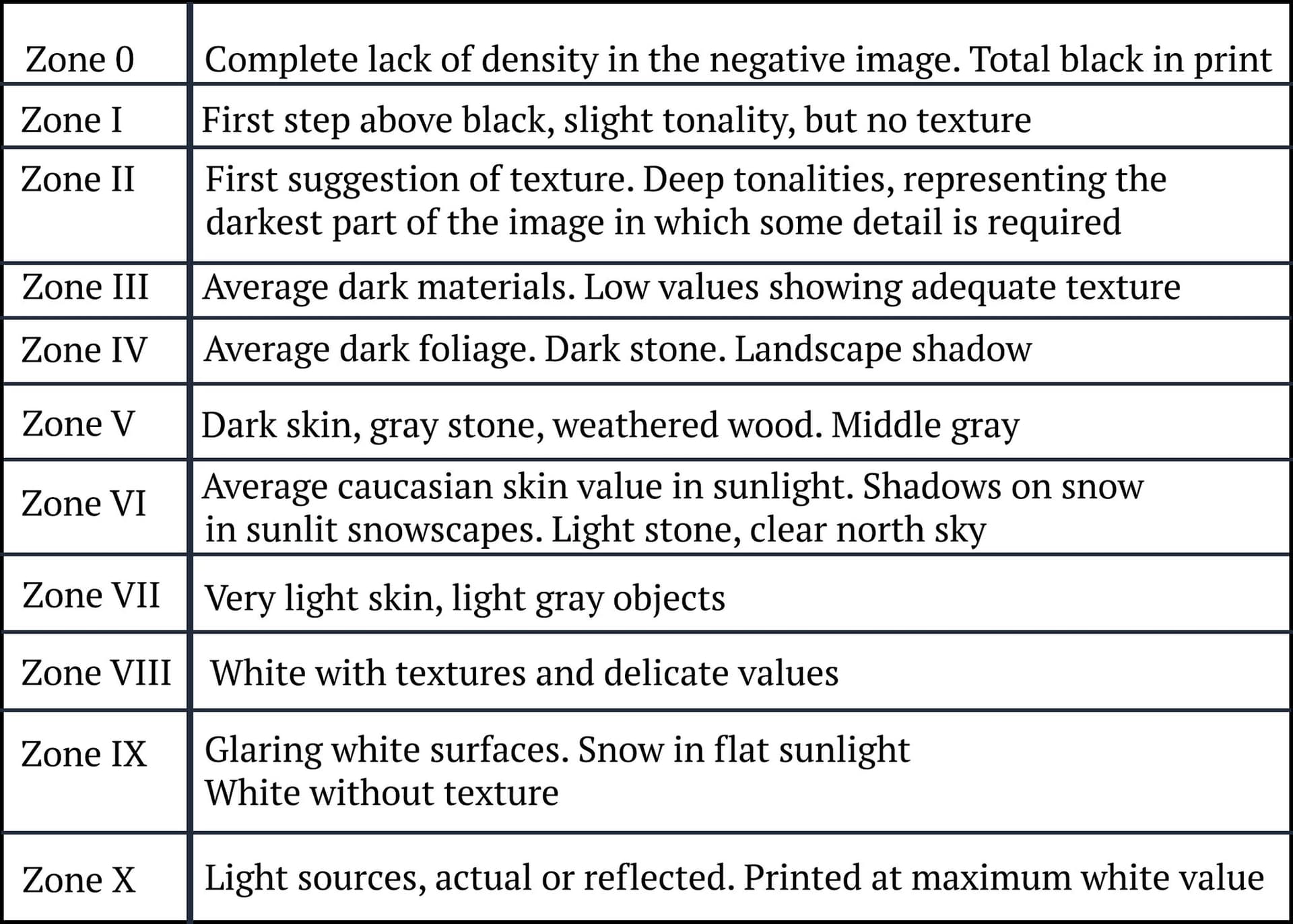 Ansel Adams Zone System
Crucially, previsualization did not stop at the negative. Adams was a lifelong, meticulous printer who returned to the same negatives across decades and printed them differently each time — usually toward greater contrast and darker skies as his aesthetic and technical confidence hardened. Print scholars and collectors have long noted that his most famous negative, Moonrise, Hernandez, New Mexico (1941), was printed by Adams with a comparatively pale, naturalistic sky in the 1940s and with an almost black, dramatically burned-in sky by the 1970s — the same negative yielding, over thirty years, two different pictures. This is not a footnote; it is direct evidence that a "documentary" landscape photograph's meaning is manufactured as much in the darkroom, print by print, as in the field. In his later years, with his health declining, Adams also relied on studio assistants to help produce the very large exhibition and commercial prints in demand from an increasingly commercial market — a fact documented in Mary Street Alinder's biography and relevant to any claim that a late Adams print represents his hand alone.
"The negative is the equivalent of the composer's score, and the print the performance."
— Ansel Adams, The Negative (1948; rev. 1981)
Major works: Eight Photographs That Built the Canon
Monolith, the Face of Half Dome
Yosemite National Park, 1927. Made with a glass-plate view camera and, on the second of two exposures, a deep red filter that darkened the sky dramatically against the lit granite face. Adams later described consciously visualizing this dark-sky effect before exposing his last plates — an origin story he repeated throughout his life as the birth of previsualization. Whether the anecdote is precisely accurate in every retelling (Adams told it more than once, with minor variations, across decades) matters less than what the image demonstrates: that a "straight," unmanipulated negative could still be a fully authored, pre-decided composition. It is the hinge between his Pictorialist beginnings and the sharp-focus modernism of Group f/64.
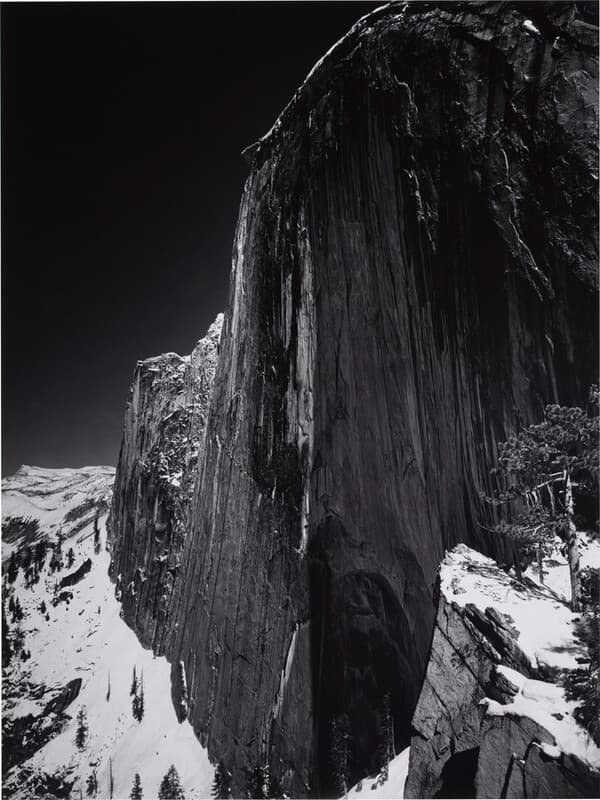 Monolith, the Face of Half Dome, 1927
"Monolith, the Face of Half Dome", 1927
Frozen Lake and Cliffs
Sierra Nevada, California, 1932. An abstracted, near-geometric composition of ice, rock, and reflection made in the immediate aftermath of Group f/64's founding. There is almost no spatial orientation offered to the viewer — no horizon, no human scale — and the picture reads closer to a modernist still life than to a scenic view. It is a useful corrective to the idea that Adams was only ever a maker of grand overlooks; here the "pure photography" doctrine is applied to something closer to pattern and texture than to the sublime.
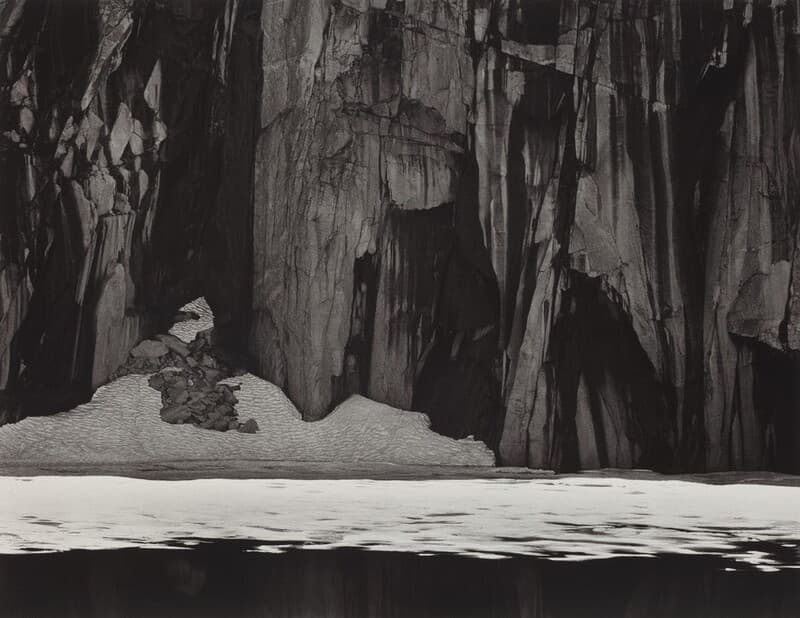 Frozen Lake and Cliffs, 1932 — J. Paul Getty Museum
"Frozen Lake and Cliffs", 1932 — J. Paul Getty Museum
Clearing Winter Storm
Yosemite National Park, c. 1935–1944 (sources differ on the exact date). A view across the valley floor toward El Capitan and the surrounding cliffs as storm clouds break apart, snow-dusted rock catching light against dark, moving cloud. The picture depends entirely on timing — Adams waited, returned, and re-photographed this view repeatedly over years to catch the specific atmospheric moment — and on darkroom control to hold detail in both the brilliant snow and the near-black storm shadow simultaneously, a range no film of the era captured straightforwardly without the photographer's intervention. It has become one of the most reproduced Yosemite images in the canon, to the point of near-total commercial ubiquity on posters and calendars, a fact relevant to later criticism of Adams's work as having been flattened by its own popularity.
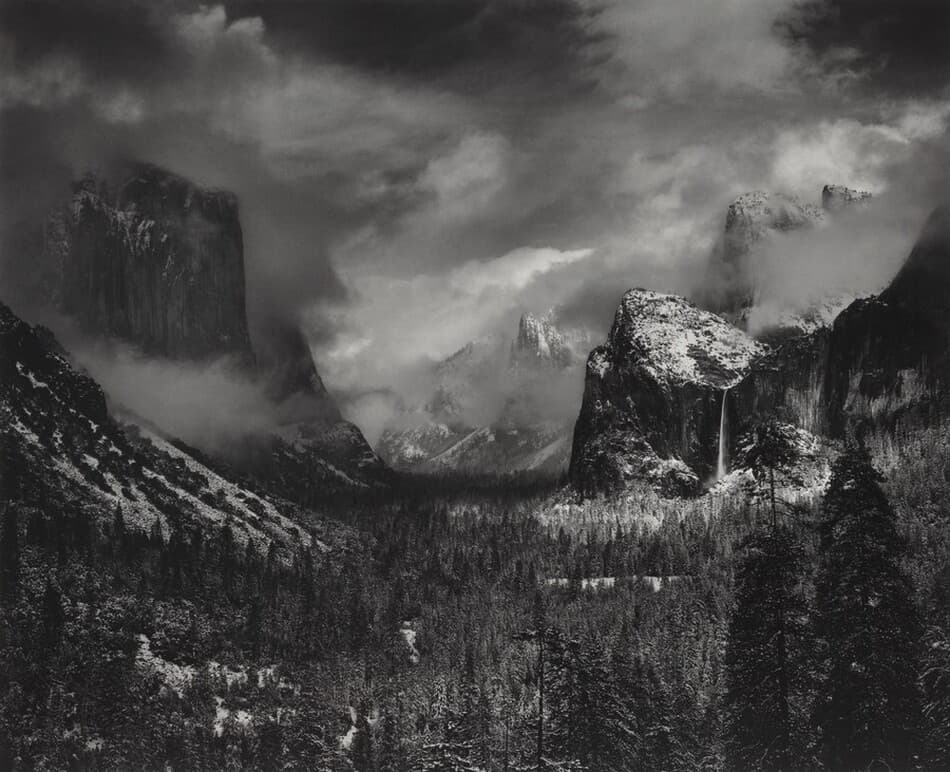 Clearing Winter Storm, Yosemite National Park
"Clearing Winter Storm, Yosemite National Park"
Moonrise, Hernandez, New Mexico
Hernandez, New Mexico, November 1, 1941. Made in a matter of minutes from the side of the road while Adams was returning from a Southwest survey trip connected to a federal mural commission; he later recounted having no time to take a full light-meter reading and calculating exposure from the known luminance of the moon itself. A row of white crosses in a small cemetery sits beneath a rising moon, backed by a dark sky and a strip of sunlit cloud. It became his single most famous, most reproduced, and most litigated image — Adams and, later, his estate pursued legal action over unauthorized reproductions for decades — and it is also the clearest documented case of a negative's meaning shifting with printing choices: later prints render the sky almost black, a far more theatrical, less naturalistic image than his 1940s prints of the same negative.
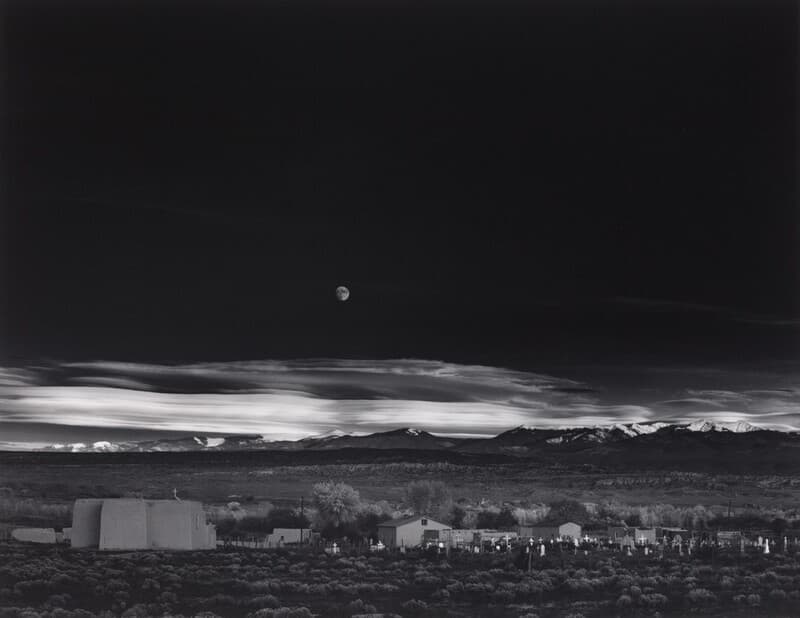 "Moonrise, Hernandez, New Mexico," 1941 — Metropolitan Museum of Art collection
"Moonrise, Hernandez, New Mexico", 1941 — Metropolitan Museum of Art collection
Mount Williamson, Sierra Nevada, from Manzanar
Manzanar War Relocation Center, California, 1944. A field of boulders below the sublime rise of Mount Williamson, photographed by Adams during the same visits that produced his Manzanar portraits and landscapes for the book "Born Free and Equal". Read on its own, it is a formally accomplished Sierra landscape. Read in context — made from within the fenced perimeter of a camp where the United States government had incarcerated more than ten thousand Japanese Americans, most of them citizens, without charge — it becomes a striking instance of a photographer's aesthetic priorities overriding the immediate human reality of the place he was standing in. Scholars have pointed to this juxtaposition as evidence that Adams's Manzanar project, whatever its sympathetic intentions, subordinated the incarcerated people's rupture and injustice to a visual language built for scenic transcendence.
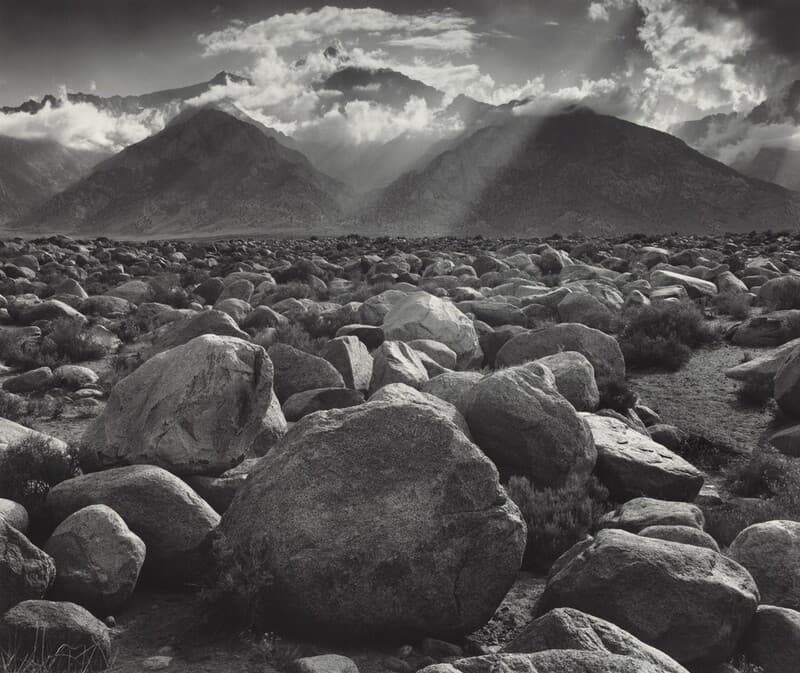 "Mount Williamson, Sierra Nevada, from Manzanar, California," 1944 — Library of Congress
Tom Kobayashi, Manzanar Relocation Center
Manzanar, California, 1943, from the same project. A three-quarter portrait of a young incarcerated man standing before an open, mountain-backed field, formally composed with the same care Adams gave his landscapes. The Manzanar project, commissioned informally at the invitation of the camp's director Ralph Merritt and published as Born Free and Equal (1944), is the most ethically contested body of Adams's career. Adams's own framing — emphasizing loyalty, resilience, and the incarcerated people's capacity to "rise above" their circumstances — stands in sharp contrast to Dorothea Lange's photographs of the same and other camps for the War Relocation Authority, which were more visibly critical of the injustice and which the government impounded for the duration of the war. Whether Adams's approach constitutes humane advocacy within a censorious wartime climate, or a softer complicity that made incarceration look survivable and even dignified rather than illegal, remains a live and legitimate critical argument rather than a settled verdict.
 "Tom Kobayashi, Manzanar Relocation Center," 1943 — Library of Congress
The Tetons and the Snake River
Grand Teton National Park, Wyoming, 1942. Made as part of Adams's 1941–42 Department of the Interior commission to photograph national parks for mural-scale display, this image — a river bend leading the eye toward the jagged Teton range — was later chosen, without Adams's direct involvement in the selection process, for inclusion on the 1977 Voyager Golden Record sent into space aboard the Voyager probes as a representative image of Earth. Its selection for that purpose is itself a piece of cultural history: NASA's committee reached for an Adams landscape as visual shorthand for "nature, unpeopled and sublime".
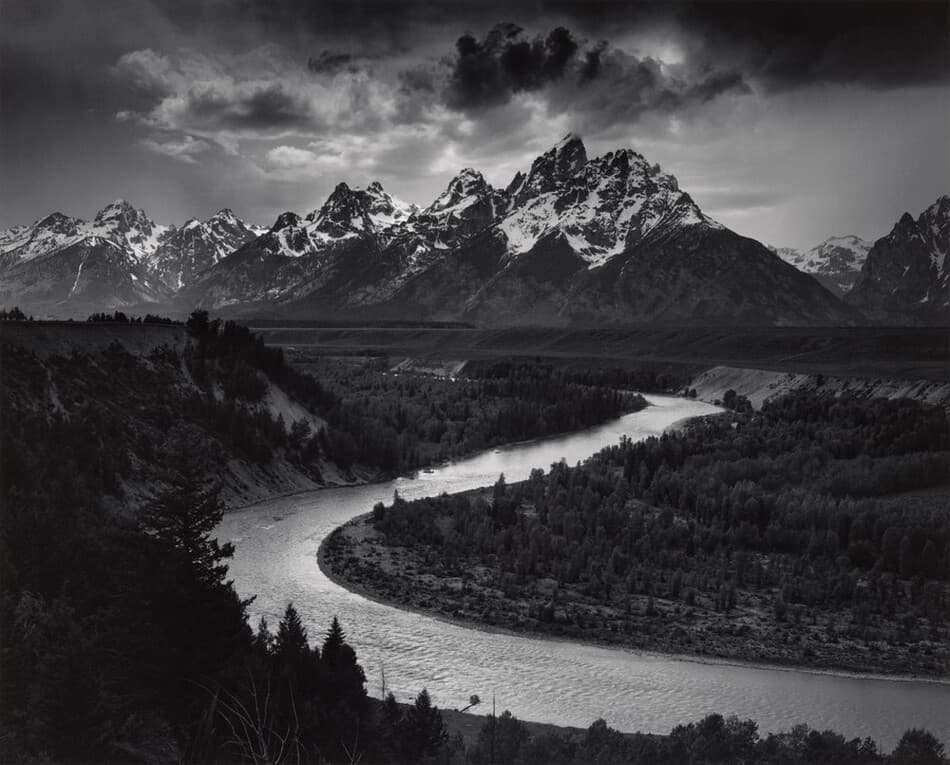 "The Tetons and the Snake River," 1942 — National Archives (Records of the National Park Service)
*"The Tetons and the Snake River," 1942 — National Archives *
Aspens, Northern New Mexico
Near Santa Fe, New Mexico, 1958. A vertical composition of aspen trunks and autumn foliage, printed in several notably different tonal versions — some warmer and more naturalistic, one especially well-known version rendered in stark, near-graphic black and white with the foliage gone nearly white. Made late in his career, well past the Group f/64 period, it shows Adams applying the same darkroom-driven previsualization to an intimate, almost abstract subject rather than a grand overlook, and it is frequently cited by print specialists as the clearest demonstration that "the same picture" from Adams could be several distinct artistic statements depending on which print one is looking at.
"Aspens, Northern New Mexico," 1958 — San Francisco Museum of Modern Art
*"Aspens, Northern New Mexico," 1958 — San Francisco Museum of Modern Art *
Themes: The Sublime, Scrubbed Clean
Across roughly six decades of work, three connected themes recur, and each is genuinely contestable rather than simply celebratory.
The first is the construction of an empty wilderness. Adams's national park and Sierra Nevada photographs overwhelmingly exclude other human beings, roads, lodges, and the visible infrastructure of tourism that made his own access to these places possible — and they are almost entirely silent on the fact that Yosemite and the Sierra Nevada were inhabited, managed, and shaped for millennia by Indigenous peoples, including the Ahwahneechee and other Miwok and Mono communities forcibly displaced to create the "pristine" park in the first place. This is not merely an absence; it is an aesthetic choice repeated so consistently across a body of work that it constitutes an argument — that wilderness is most valuable, most photographable, and most worth legally protecting precisely when it appears untouched by human history. Environmental historians have long noted that this vision, echoed by the Sierra Club's exhibit-format publications that Adams's images anchored, shaped a strand of American conservation politics that prioritized scenic, unpeopled landscapes over land actually used and inhabited by working and Indigenous communities.
The second theme is the deliberate fusion of technical control with political advocacy. Adams was never a passive documentarian of scenery; his photographs of the Sierra Nevada were explicitly produced and circulated — bound into books like Sierra Nevada: The John Muir Trail (1938), sent to members of Congress — to build the case for specific legislative protections, including the 1940 creation of Kings Canyon National Park. The Zone System and his obsessive printing practice were not neutral technique in service of some separate advocacy; they were the advocacy, because a more dramatic, more tonally commanding print was, in Adams's own understanding, a more persuasive one.
The third, more uncomfortable theme is the limit of that visual language when it met a genuinely political subject. The Manzanar project shows what happens when a photographic grammar built for granite and cloud is turned toward human injustice: it produces images that are formally beautiful, historically valuable as documentation that the incarceration happened and that individuals within it retained dignity, and simultaneously inadequate — by comparison with Lange's contemporaneous work — as a visual indictment of the policy itself.
Legacy: Wilderness Law, Archives, and the Price of Ubiquity
Adams's institutional recognition was substantial and sustained. He received three Guggenheim Fellowships (1946, 1948, and 1958) to photograph the national parks; he helped Beaumont Newhall establish photography as a curatorial department at the Museum of Modern Art beginning in 1940, a foundational moment for photography's acceptance as fine art in American museums; and in 1980 President Jimmy Carter awarded him the Presidential Medal of Freedom, citing his contribution to American conservation as much as to art. After his death, both a peak (Mount Ansel Adams) and a large wilderness area in the Sierra Nevada (the Ansel Adams Wilderness) were named for him — an honor that quite literally inscribes his name onto the landscape his photographs helped protect.
The criticism has been persistent too, and not only about Manzanar. Some critics and fellow photographers, including voices within the documentary and street-photography traditions, faulted Adams's landscapes for their near-total absence of people, politics, and labor at a moment — the Depression, the Second World War, the civil rights era — when American photography's most urgent work was being done by photographers pointed at exactly those subjects. The sheer commercial reproduction of his most famous images, endlessly recirculated on posters, calendars, and mugs, has also fed a recurring critique that Adams's later ubiquity cheapened work that had once been formally radical; the Ansel Adams Publishing Rights Trust's tight, litigious control of reproduction rights — including lawsuits over unauthorized commercial use of his images — reflects an estate keenly aware of how easily that popularity could be exploited, and of how much money is still at stake in it.
His personal archive found an institutional home during his lifetime: Adams helped establish the Center for Creative Photography at the University of Arizona in 1975, and on his death in 1984 the bulk of his negatives, working papers, and correspondence passed there, alongside archives of colleagues including Edward Weston. Separately, and significantly for questions of public access, Adams donated the original Manzanar negatives directly to the Library of Congress and explicitly dedicated them to public use — a rare instance in his career of relinquishing the tight control he otherwise exercised over his own image.
Adams died of heart failure on April 22, 1984, at a hospital on the Monterey Peninsula, at 82. He remained, until the end, both a working photographer and an active conservation lobbyist, corresponding with and lobbying four American presidents on wilderness policy. That double identity — meticulous technician and unapologetic advocate — is the throughline this essay has tried to trace: not a photographer who found beauty and happened to preserve it, but one who engineered beauty, exposure by exposure and print by print, as a deliberate instrument of persuasion. The instrument worked, protecting real acres of real wilderness. It also, by its own design, left almost everyone out of the picture.
Books
Selected books by Ansel Adams
| Title | Author/editor | Year | Publisher | Focus | |
|---|---|---|---|---|---|
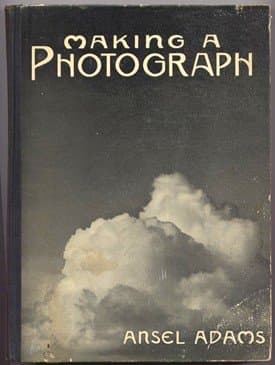 Making a Photograph | Making a Photograph | Ansel Adams | 1935 | The Studio publications inc | His first instructional book, written while still transitioning away from Pictorialism. |
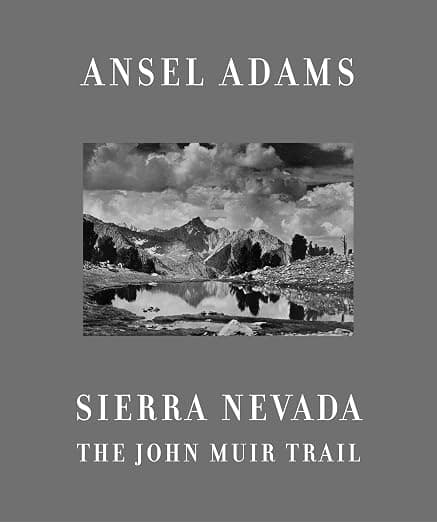 Sierra Nevada: The John Muir Trail | Sierra Nevada: The John Muir Trail | Ansel Adams | 1938 | Archetype Press (self-published) | Conservation advocacy volume distributed to Congress ahead of Kings Canyon National Park's 1940 creation. |
 Born Free and Equal | Born Free and Equal: The Story of Loyal Japanese-Americans | Ansel Adams | 1944 | U.S. Camera Publishing | His controversial Manzanar project; contested for softening the politics of incarceration. |
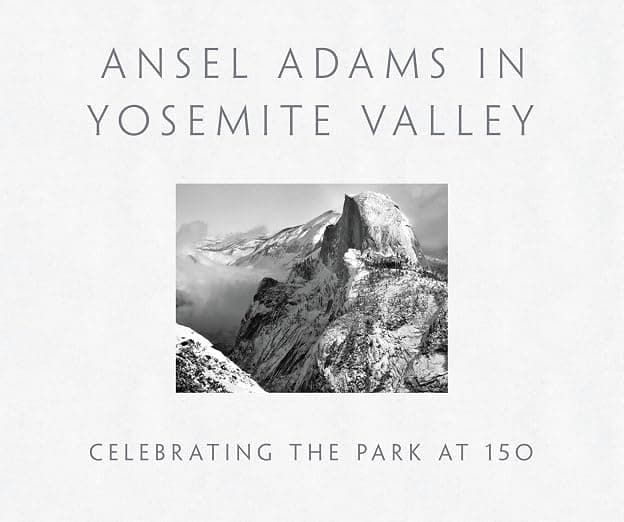 Ansel Adams in Yosemite Valley: Celebrating the Park at 150l | Ansel Adams in Yosemite Valley: Celebrating the Park at 150 | Ansel Adams, Peter Galassi | 2014 | Little, Brown and Company | A magnificent deluxe, oversized book timed for the 150th anniversary of Abraham Lincoln's signing of the Yosemite Grant, an event that laid the groundwork for the National Parks system. |
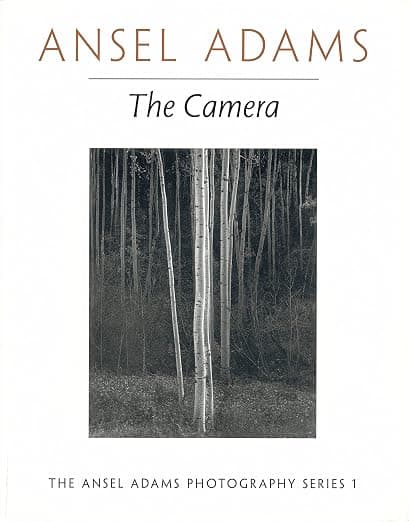 # The Camera | The Camera | Ansel Adams | 1948 | Ansel Adams | The first volume in Adams' celebrated series of books on photographic techniques--has taught generations of photographers how to harness the camera's artistic potential. |
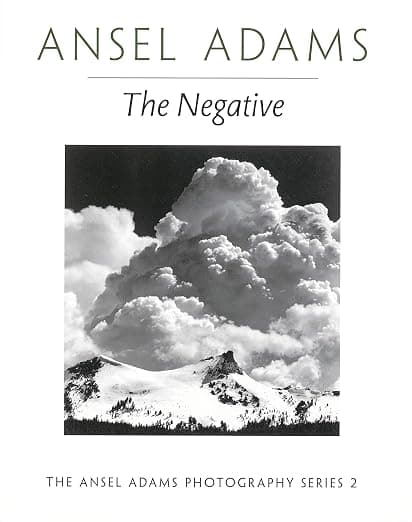 The Negative | The Negative | Ansel Adams | 1948 | Morgan & Morgan | The second volume in Adams' celebrated series of books on photographic techniques--has taught generations of photographers how to use film and the film development process creatively |
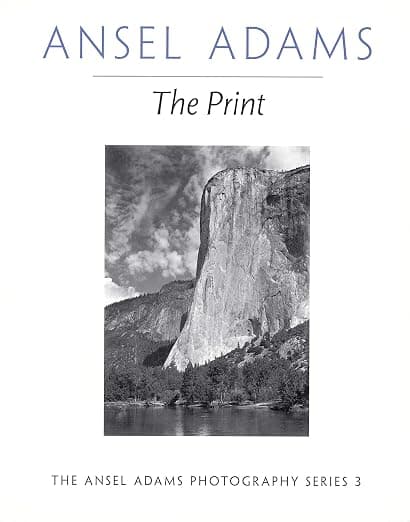 The Print | The Print | Ansel Adams | 1948 | Morgan & Morgan | The third volume in Adams' celebrated series of books on photographic techniques--has taught generations of photographers how to explore the artistic possibilities of printmaking |
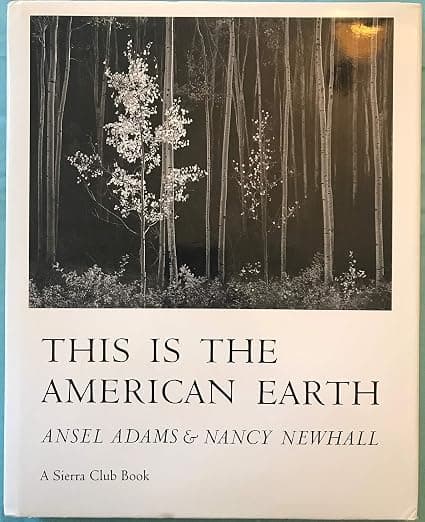 This is the American Earth | This Is the American Earth | Ansel Adams (photographs), Nancy Newhall (text) | 1960 | Sierra Club | Founding volume of the Sierra Club's influential Exhibit Format book series linking photography to conservation politics. |
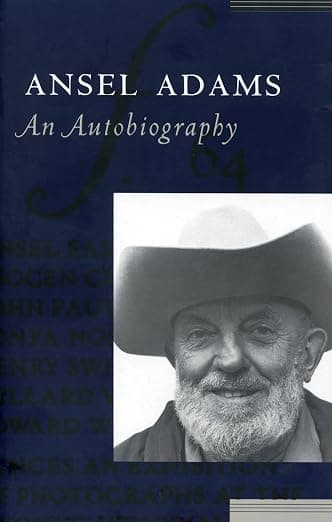 Ansel Adams: An Autobiography | Ansel Adams: An Autobiography | Ansel Adams | 1985 | Little, Brown | Discover this "evocative celebration of the life, career, friendships, concerns, and vision" of Ansel Adams, America's greatest photographer |
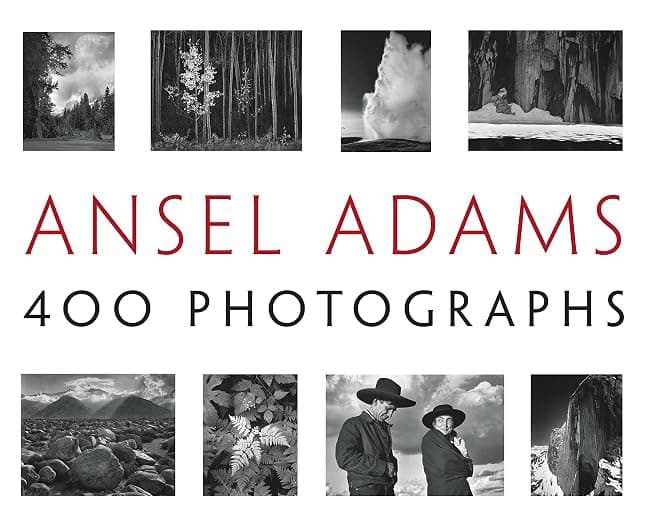 Ansel Adams: 400 Photographs | Ansel Adams: 400 Photographs | Ansel Adams | 2007 | Ansel Adams | Presents the full spectrum of Adams' work in a single volume for the first time, offering the largest available compilation from his legendary photographic career. |
Books about Ansel Adams
| Title | Author/editor | Year | Publisher | Focus | |
|---|---|---|---|---|---|
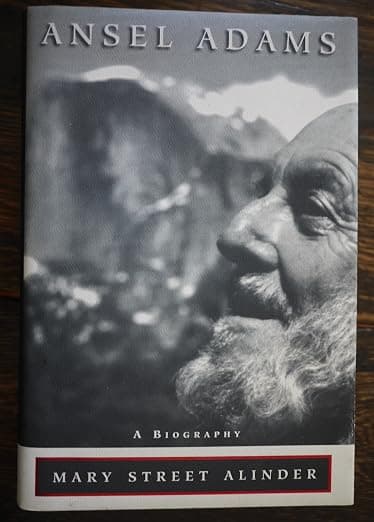 Ansel Adams: A Biography | Ansel Adams: A Biography | Mary Street Alinder | 1996 | The Studio publications inc | His first instructional book, written while still transitioning away from Pictorialism. |
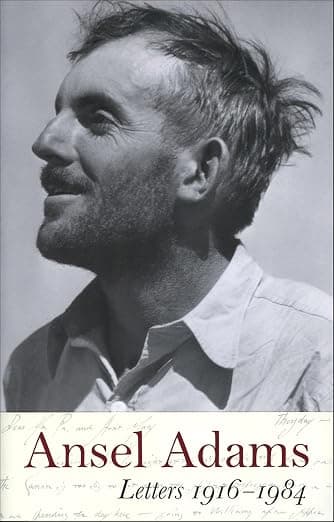 Ansel Adams: LETTERS, 1916–1984 | Ansel Adams: Letters and Images, 1916–1984 | Mary Street Alinder, Andrea Gray Stillman | 1988 | Little, Brown and Company | Primary-source correspondence tracing his development, friendships, and conservation work. |
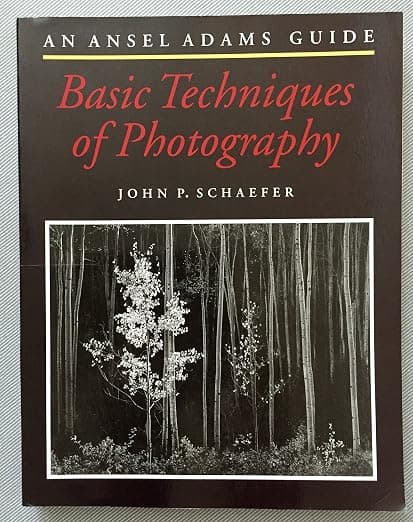 An Ansel Adams Guide: Basic Techniques of Photography | The Ansel Adams Guide: Basic Techniques of Photography | John P. Schaefer | 1992 | Bulfinch Press | Scholarly technical reconsideration of the Zone System and Adams's darkroom methods. |
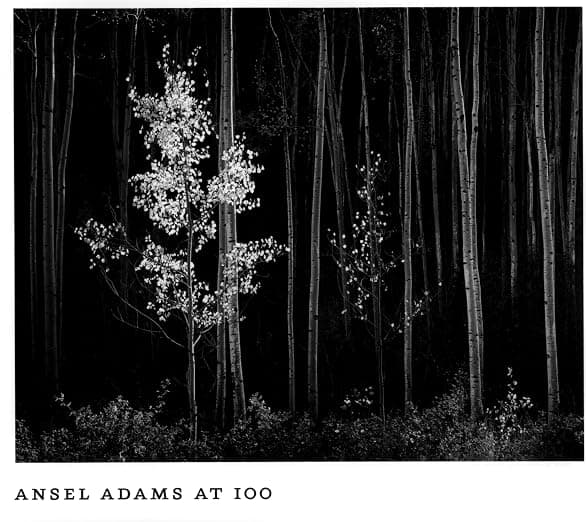 Ansel Adams at 100 | Ansel Adams at 100 | John Szarkowski | 2001 | Little, Brown | The legendary curator John Szarkowski has painstakingly selected what he considers Adams' finest work and has attempted to find the single best photographic print of each. |
Films
| Film title | Year | Director | Production | Relevance | |
|---|---|---|---|---|---|
 Ansel Adams: A Documentary Film | Ansel Adams: A Documentary Film | 2002 | Ric Burns | Steeplechase Films, for PBS American Experience | The principal dedicated biographical film, covering his life, method, and conservation advocacy with archival interviews. |
 Ansel Adams, Photographer | Ansel Adams, Photographer | 1957 | David Myers | David Myers | Records the life and work of Ansel Adams. Dwells on his equipment, home, interests, and his attitude toward art, photography and life. |
 Ansel Adams, Photographer | Ansel Adams, Photographer | 1981 | John Huszar | John Huszar | Adams discusses his artistic vision, his pioneering darkroom and camera techniques, and his vital roles as an artist, educator, and environmental conservationist. It features footage shot on location at his home and studio in Carmel/Big Sur, California, alongside many of his most famous black-and-white western photographs |
Sources
Official website, estate, or archive
- The Ansel Adams Gallery / Ansel Adams Publishing Rights Trust — Official estate site
- Center for Creative Photography, University of Arizona — Primary archive of Adams's negatives and papers
Museums, galleries, and archives
- Museum of Modern Art — Ansel Adams collection — MoMA
- J. Paul Getty Museum — Ansel Adams works — Getty Museum
- Metropolitan Museum of Art — Ansel Adams works — The Met
- San Francisco Museum of Modern Art — Ansel Adams works — SFMOMA
- Library of Congress — Manzanar War Relocation Center Photographs collection — Library of Congress
- National Archives — Records of the National Park Service, Ansel Adams photographs — NARA