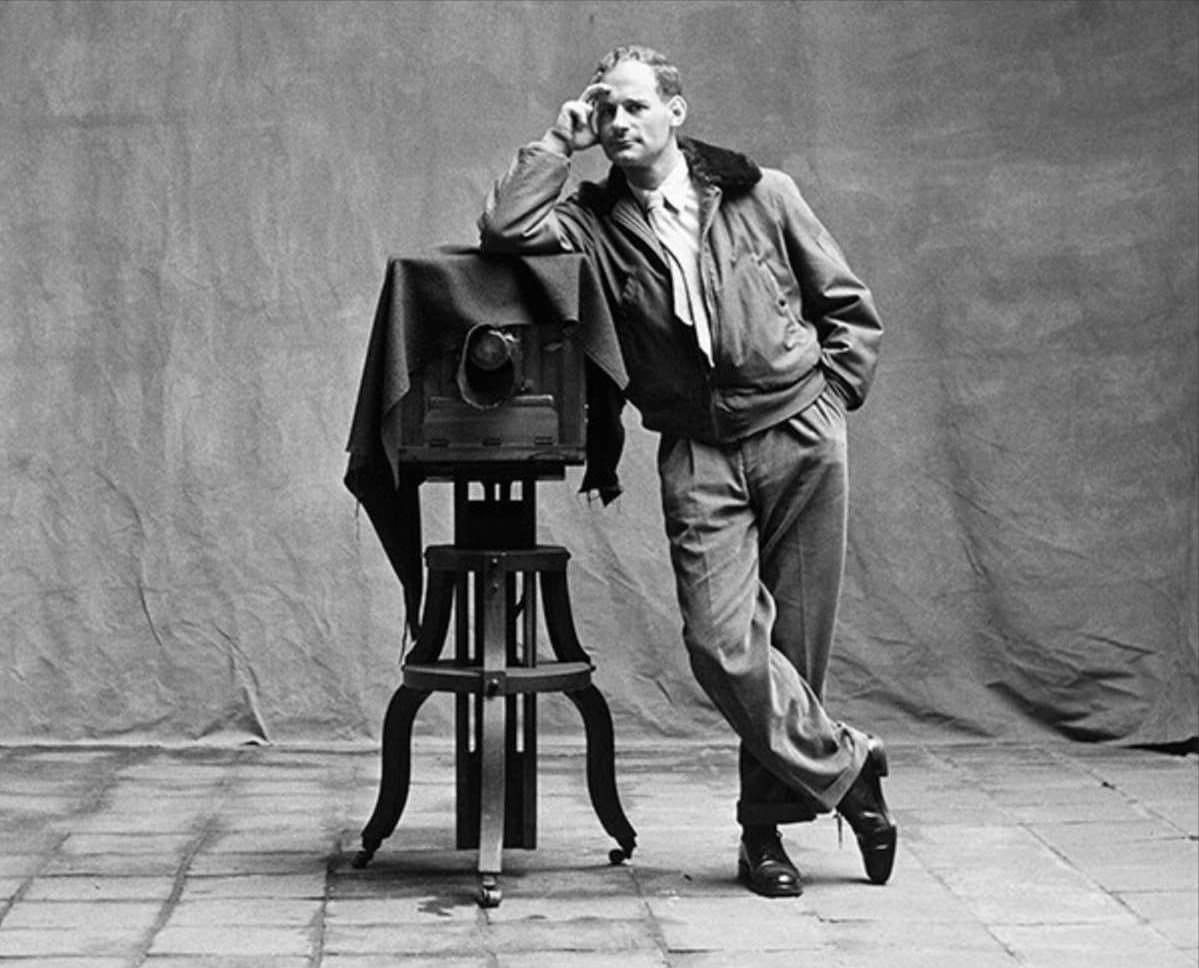
Irving Penn and the Discipline of the Bare Backdrop
Masters · 9/19/2026
The photographer who turned emptiness into a laboratory for the human face.
Irving Penn at a glance
| Full name | Irving Penn |
| Life | June 16, 1917, Plainfield, New Jersey – October 7, 2009, New York City |
| Nationality | American |
| Genres | Fashion, portraiture, still life, ethnographic documentary |
| Active | 1943–2007 (approx.) |
| Places | New York; Paris; Lima/Cuzco; Dahomey; Morocco; New Guinea |
| Official / archive | The Irving Penn Foundation |
| Selected distinctions | Royal Photographic Society Progress Medal (1991); Infinity Award, ICP; MoMA retrospective, 1984 |
An Irving Penn photograph often begins by taking the world away. A person stands before a plain wall or weathered cloth. A dress loses the ballroom it might have occupied. A worker is separated from the street but keeps the tools of a trade. A flower is detached from the garden; a cigarette end from the gutter. What remains appears almost unnaturally available to sight. Texture, posture, wear, and edge acquire the force that scenery usually carries.
This reduction is sometimes described as elegance, but elegance alone does not explain Penn’s achievement. His studio was a machine for comparison. It subjected radically different things to the same slow, exact scrutiny. The method could be generous: people and objects overlooked by magazines received the visual ceremony normally reserved for couture and fame. Yet the same formal equality could also conceal unequal conditions. A Parisian tradesperson, a Vogue model, and an Indigenous sitter photographed during a Western magazine assignment did not enter the studio with the same power, history, or control over circulation.
Penn’s importance lies in this productive tension. He proved that commercial photography could possess the formal concentration and material ambition of museum art. He also made pictures whose controlled beauty requires us to ask what the studio removes, who benefits from that removal, and whether aesthetic consistency can ever neutralize social difference.
Life: From design school to Vogue
A commercial illustrator's training turned toward the camera
Penn was born in 1917 in Plainfield, New Jersey, to Russian-Jewish immigrant parents. He did not enter photography through a camera club or newsroom. He entered through graphic design.
Irving studied design from 1934 to 1938 at the Philadelphia Museum School of Industrial Art (now the University of the Arts) under Alexey Brodovitch, the influential art director of Harper's Bazaar, who introduced him to European modernist graphic sensibilities.
That formation explains why Penn’s pictures so often feel already aware of the page. He understood scale, blank space, sequence, and the relation between image and type before photography became his profession. In 1938 he bought a Rolleiflex with earnings from drawings published in Harper’s Bazaar. He worked in New York as an art director for Junior League magazine and Saks Fifth Avenue, then left in 1941 to travel through the American South and spend a year painting in Mexico. Dissatisfied, he destroyed most of the paintings. Photography, initially a companion to the journey, proved more durable than his ambition to become a painter.
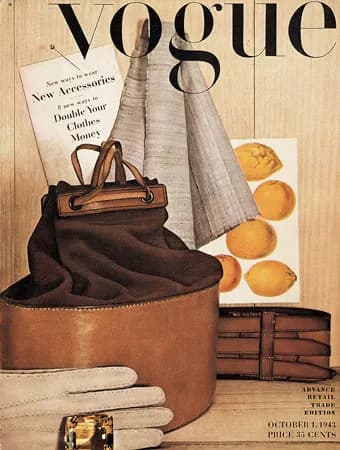
Alexander Liberman hired Penn at Vogue in 1943 to prepare layouts and propose covers. Liberman recognized in the travel contact sheets a disciplined eye and encouraged him to make the photographs he wanted the magazine to publish. Penn’s first professional color still life became the 1 October 1943 cover. From the beginning, then, photographer and art director were not separate identities: Penn conceived the subject, its arrangement, and its destination on the printed page.
 Vogue
Vogue, 1943
He volunteered with the American Field Service in 1944–45, serving as an ambulance driver and photographing in Italy. Back at Vogue, he began sustained portrait campaigns of writers, artists, performers, and designers. In 1948 he traveled through Europe and Peru for the magazine. After finishing a fashion assignment in Lima, he remained in Cuzco and rented a local daylight studio, paying residents and visitors who agreed to sit. That experience—an improvised neutral room within an unfamiliar place—became the prototype for his later portable tent.

In Paris in 1950, Penn photographed the couture collections in a daylight studio against an old theatre curtain. The model Lisa Fonssagrives, trained as a dancer, understood clothing as line, balance, and controlled motion; she and Penn married that year. Their collaboration became one of the defining exchanges between photographer and model in postwar fashion. At the same time, Penn photographed the Small Trades in Paris, London, and New York, bringing workers into the same stripped studio used for fashion.
 Harlequin Dress (Lisa Fonssagrives-Penn)
, 1950
When Vogue editors reduced his assignments in the early 1950s because the images seemed too severe for the magazine, Penn expanded into advertising. The change was not a retreat. It made still life a commercial laboratory: strobe lighting, precise arrangement, and graphic compression could make food, cosmetics, or manufactured objects look newly strange. He returned repeatedly to editorial fashion, eventually making 165 Vogue covers, but advertising and personal projects kept testing the supposed boundary between use and art.
Method: The studio as a measuring instrument
The corner, the north light, and a refusal of spectacle
Penn worked for decades with a large-format view camera, most famously an 8x10 studio camera used with north-facing daylight or simple tungsten/flash setups, favoring a plain paper or canvas backdrop and minimal or no additional set dressing
The Foundation describes Worlds in a Small Room as a kind of love letter to the camera because its waist-level viewing allowed Penn to maintain contact with sitters. Usually he made careful technical choices documented in worksheets. The Art Institute archive preserves records of equipment, film stock, emulsion batches, negatives, contact prints, exposure and printing decisions. Precision was not retrospective mythology; it was administrative practice. He also selected obsessively from contact sheets, and cropping and dodging decisions — not the "decisive moment" — were where his pictures were finally made.
He usually preferred a neutral background, natural daylight or controlled side light, and enough time for posture to become deliberate. For early cultural portraits, he built a narrowing corner from two angled walls or offered sitters a worn carpeted block. These devices were constraints rather than neutral scenery. Some subjects pressed into the angle; others resisted it, performed for it, or used it as a stage. The portrait resulted from how a person negotiated Penn’s structure.
Travel magnified the system. After adapting garages and barns, Penn designed a portable tent studio in 1967. Diffused natural light entered a controlled enclosure, temporarily separating sitters from the visible landscape. The tent made pictures from Dahomey (now Benin), Nepal, Cameroon, New Guinea, and Morocco formally comparable with photographs made in New York and Paris. It also created the central ethical question in the work: a controlled meeting may concentrate attention, but the photographer, magazine, and later museum still determine how the meeting is framed and circulated.
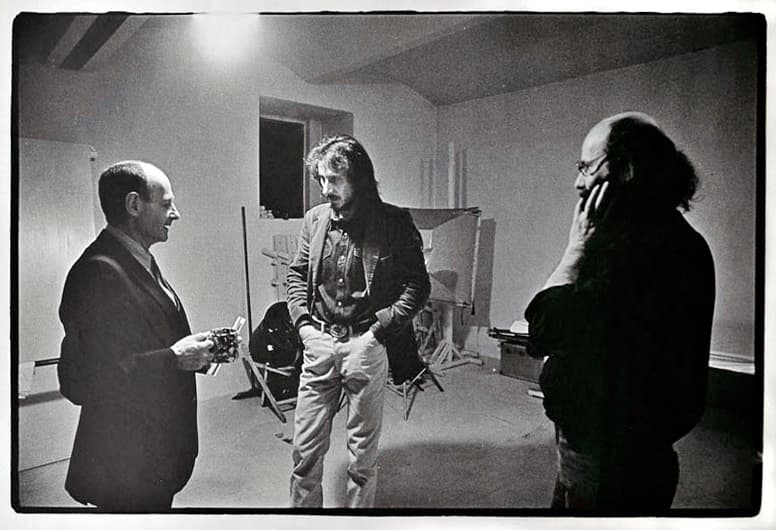 Irving Penn with Jiří Poláček and Šimánek in Prague in 1986
Jiří Poláček, Irving Penn with Jiří Poláček and Šimánek, Prague, 1986
For Penn, exposure was only the beginning. In the late 1940s he bleached and redeveloped prints of adult models to resist magazine smoothness. From the 1960s he revived platinum-palladium printing, hand-coating fine-art paper with light-sensitive metal salts, enlarging negatives for contact printing, and mounting paper to aluminum so it could survive repeated coatings and exposures. Platinum gave him a wide, quiet tonal range and a physical surface that ordinary magazine reproduction could not preserve. A Foundation technical note shows that one negative could exist as color, gelatin silver, and platinum-palladium prints. The “same photograph” could therefore become materially and emotionally different.
Penn’s contact sheets reinforce the impression that many images were substantially designed before the shutter was released. The Art Institute notes that some fashion sequences contain only slight pose variations. Editing remained exacting, but chance was narrowed by preparation. His art was not the quick discovery of an uncontrolled moment. It was the gradual production of conditions in which small changes became decisive.
Major works
Still Life with Food, New York, 1947
Fruit, bread, tableware, and scattered remnants occupy a tabletop whose order feels both abundant and unstable. The arrangement invokes seventeenth-century still life but belongs to a modern magazine world of appetite, consumption, and reproduction. Bright color separates ingredients while the overhead view compresses them toward graphic pattern. Penn later printed the negative in black and white as New York Still Life and in platinum-palladium. The Foundation’s comparison of print types demonstrates that the work’s meaning changes with its material form: color emphasizes edible specificity; silver translates the scene into tonal structure; platinum turns the commercial negative into a tactile art object.
 Still Life with Food, New York, 1947 — Irving Penn Foundation
Still Life with Food, New York, 1947
 Still Life with Food, New York, 1947 — Irving Penn Foundation
Still Life with Food, New York (platinum-palladium print), 1947
Twelve fashion faces flattened into one frieze
Penn arranged twelve leading models in a single group portrait, refusing the individualized glamour close-up expected of fashion photography and instead composing them like a Renaissance frieze — a compositional choice that turned commercial subjects into an art-historical tableau.
 "The Twelve Most Photographed Models of the Time," 1947 — Condé Nast/Irving Penn Foundation
"The Twelve Most Photographed Models of the Time" 1947
The corner portrait as psychological trap - Truman Capote, New York, 1948
Capote folds himself into Penn’s angled corner, hands in pockets and coat closed, producing a compact silhouette that seems simultaneously guarded and theatrical. The corner does not reveal an unprotected “true self”; it creates pressure to which the sitter responds. Capote’s downward gaze and compressed posture become meaningful because the set denies ordinary environmental clues. The result established a pattern for Penn’s cultural portraits: personality appears through negotiation with a formal obstacle.
 Truman Capote, New York, 1948 — Metropolitan Museum of Art
Truman Capote, New York, 1948
Worlds in a Small Room: portable studio, global reach
Published in 1974, this project compiled portraits made with Penn's north-light tent in Cuzco, Dahomey, Morocco, and New Guinea. The uniform lighting and backdrop across radically different cultures is the project's defining — and most contested — formal decision: it produces striking visual coherence while raising legitimate questions about a Western photographer's flattening of context in the name of aesthetic control.
Young Quechuan Man, Cuzco, December 1948
The young sitter meets the camera within a local daylight studio whose painted backdrop removes the street but not clothing, stance, or cultural specificity. Penn paid sitters rather than charging them for portraits, reversing the studio’s normal transaction. The arrangement produced concentration, yet it did not equalize control: an American photographer on assignment selected the frame, title, print, and international audience. The picture matters because dignity and asymmetry coexist. Its restraint opposes touristic spectacle, but its later category as an “ethnographic” portrait can make an individual carry the burden of representing a culture.
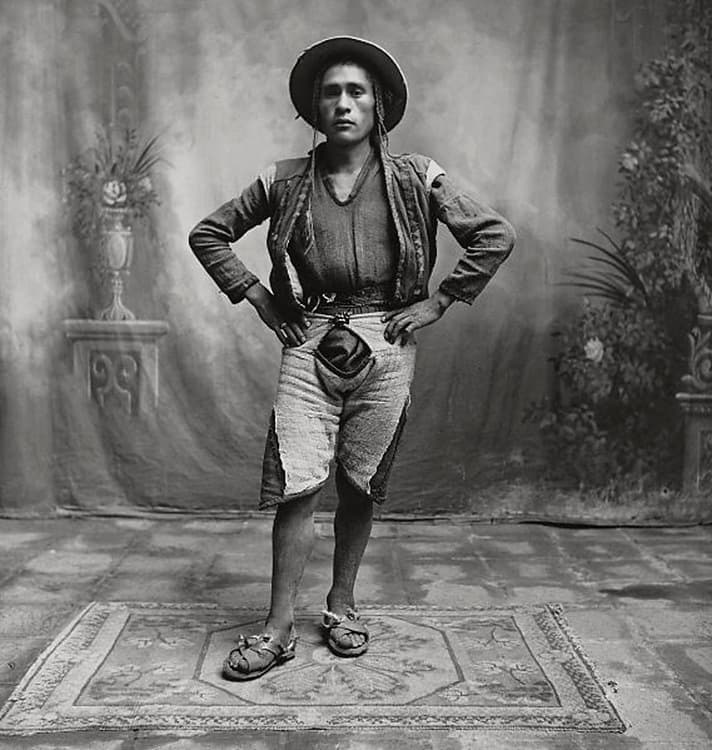 Young Quechuan Man, Cuzco, 1948 — Metropolitan Museum of Art
Young Quechuan Man, Cuzco, 1948
Rochas Mermaid Dress (Lisa Fonssagrives-Penn), Paris, 1950
The narrow-waisted dress opens into a sculptural lower shape, while Fonssagrives-Penn’s trained posture converts couture into an architecture of diagonals and curves. The old theatre curtain is not decorative Paris; its soft gray surface makes the silhouette exact. Diffused daylight preserves dark fabric detail without dissolving the form. The photograph’s authority belongs to collaboration: designer Marcel Rochas supplied the garment, the model controlled its bodily geometry, and Penn determined viewpoint, light, and final selection.
 Rochas Mermaid Dress (Lisa Fonssagrives-Penn), Paris, 1950
Small Trades, an inventory of vanishing labor
Between 1950 and 1951, in Paris, London, and New York, Penn photographed tradespeople — chimney sweeps, butchers, rag-and-bone men — in their work clothes against his studio backdrop, a project later published as Small Trades. This project refers back to European prints of street criers and disappearing occupations, but it also risks turning labor into a timeless “type.” The individual is honored by scale and attention while social conditions remain outside the frame. That double movement—dignifying a person while abstracting a profession—is central to the series. The worker stands with tools and work clothes against the same kind of neutral cloth that served fashion. The long handle establishes a vertical counterline to the body; dirt, wear, and fabric texture become evidence rather than visual noise.

Flowers, mortality in close-up
Commissioned originally for Vogue covers beginning in 1967 and later collected in the 1980 book Flowers, these images show blooms at the edge of decay — petals browning, drooping — photographed with the same clinical light Penn gave his portrait sitters, collapsing the distance between botanical study and memento mori.
Penn’s flower is not botanical documentation and not a symbol of perfect freshness. Petals twist, thin, and darken; color records a life already changing. The isolated bloom fills the frame like a portrait sitter, its stem functioning as posture and its damaged edges as biography. Made for Vogue Christmas issues, the flower pictures brought decay into a context organized around seasonal luxury. The tension is quiet rather than moralizing: beauty becomes more exact when it includes deterioration.
 Single Oriental Poppy, New York, 1968 — Metropolitan Museum of Art
Single Oriental Poppy, New York, 1968
Worlds in a Small Room: portable studio, global reach
Published in 1974, this project compiled portraits made with Penn's north-light tent in Cuzco, Dahomey, Morocco, and New Guinea. The uniform lighting and backdrop across radically different cultures is the project's defining — and most contested — formal decision: it produces striking visual coherence while raising legitimate questions about a Western photographer's flattening of context in the name of aesthetic control.
Man with Pink Face, New Guinea, 1970
Color here is not incidental: face paint, ornament, skin, and the neutral tent backdrop create a concentrated meeting of surfaces. Penn’s traveling studio removes the surrounding landscape and refuses the visual conventions of expedition photography. That decision can be read as respect because it blocks exotic scenery and grants the sitter formal presence. It can also be read as extraction because cultural appearance is detached from community, use, history, and local authorship for circulation in a Western fashion magazine. The photograph’s critical value lies in refusing an easy verdict. Formal intensity does not cancel the colonial history of looking; nor does that history erase the sitter’s visible self-possession.
Man with Pink Face, New Guinea, 1970 — Metropolitan Museum of Art
Man with Pink Face, New Guinea, 1970
Cigarette No. 37, elevating refuse
A discarded cigarette end is enlarged until paper, ash, stain, compression, and printed lettering become a damaged landscape. Penn collected such fragments from New York streets and photographed them in the studio, then printed them with the labor-intensive platinum-palladium process associated with permanence and preciousness. The clash is the point. Refuse receives costly craft, while the scale that monumentalizes it also preserves evidence of consumption.
 Cigarette No. 37, New York, 1972 — Metropolitan Museum of Art
Cigarette No. 37, New York, 1972
Themes: Equality of form, inequality of situation
Penn’s central theme is not fashion, portraiture, or still life. It is the transfer of attention. A controlled background and concentrated light allow the viewer to compare the fall of a couture sleeve, the grip of a worker’s hand, the damage to a petal, and the fibers of a cigarette paper. The method challenges hierarchies of subject matter. Nothing is too commercial to become formally serious, and nothing is too ordinary or discarded to command a magnificent print.
That equality is aesthetic, not social. Small Trades places workers in the visual language of fashion, but the trade remains a label while the economic world of work disappears. The traveling tent blocks picturesque scenery, but Vogue and Penn still control the encounter’s destination. His portraits of named cultural figures preserve individuality; many travel portraits use descriptive categories that can make the sitter stand for a group. Critical reading should not reduce all these photographs to exploitation, but neither should “timeless dignity” end the discussion. Neutrality is an effect produced by removing context, and removal is an editorial act.
The same argument applies to the adult nude studies of 1949–50. Penn chose bodies outside the sleek proportions promoted by fashion magazines, photographed at close range, and altered prints through bleaching and redevelopment. The project challenged the polished body ideal of his commercial work, yet the photographer still exercised control through cropping, selection, and delayed exhibition. Its importance is not that it simply “celebrated” or “distorted” bodies; it made printing and framing part of how a body becomes culturally legible.
Across genres, decay prevents Penn’s classicism from becoming sterile. Aging flowers, food remains, bones, street debris, and cigarettes disturb the fantasy of permanent perfection. Platinum printing deepens the paradox. A process valued for stability and tonal richness gives durable form to fragile or unwanted things. Penn’s finest images are therefore less about perfection than about disciplined attention to impermanence.
Legacy: Discipline after fashion
Penn’s institutional reputation developed alongside, not after, his commercial career. He held his first commercial exhibition at Alexander Iolas Gallery in 1960. His cigarette pictures appeared at MoMA in 1975, and the Met presented Street Material in 1977. John Szarkowski organized the major MoMA retrospective that opened in 1984 and toured through 1989. Penn received the Hasselblad Award in 1985. The Art Institute of Chicago mounted A Career in Photography in 1997; the Smithsonian presented Beyond Beauty in 2015; and the Met’s 2017 centennial exhibition assembled more than two hundred photographs.
His late career did not settle into repetition. Beginning in 1986, he developed a long-distance collaboration with Issey Miyake, translating the designer’s sculptural clothes into photographs rather than merely documenting garments. He built special cameras for pavement debris, experimented with moving bands of light during long exposures, returned to painting and drawing, and adopted digital color printing. He continued making portraits, fashion, beauty, and still lifes for Vogue into the twenty-first century.
Penn also curated his own future. In 1995 he donated most of his paper and photographic archive, together with 130 fine-art prints, to the Art Institute of Chicago. The material arrived methodically organized. Negatives, transparencies, correspondence, studio diaries, worksheets, contact sheets, test prints, and technical records permit scholars to reconstruct not only what he published but how he decided. He established the Irving Penn Foundation in 2005; it now preserves the largest repository of his work, supports scholarship, places prints in public collections, and manages or helps identify reproduction rights.
Penn died at home in New York in 2009, aged ninety-two. His influence is visible in the clean backgrounds and object-like fashion images that now appear everywhere, but imitation often keeps only the surface. The deeper lesson is more demanding. Simplicity was not a shortcut; it required preparation, collaboration, editing, material knowledge, and an awareness of publication. Nor was a plain background innocent. The room that seemed to make everything equal also made every difference—of texture, posture, status, and power—harder to ignore.
Books
Selected books by Irving Penn
| Book | Title | Author/editor | Year | Publisher | Why it matters |
|---|---|---|---|---|---|
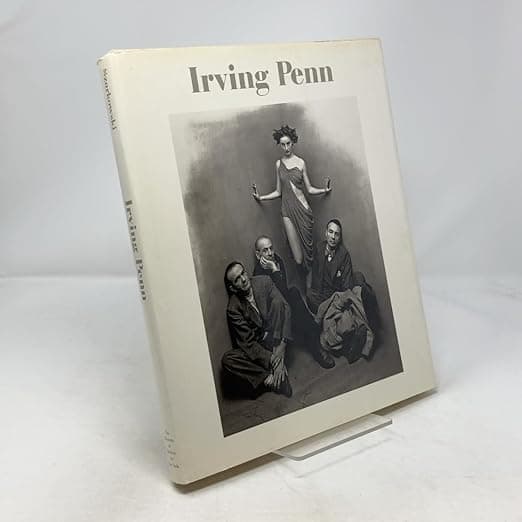 Irving Penn | Irving Penn | Irving Penn, John Szarkowski | 1984 | Museum of Modern Art | Published in conjunction with an exhibition at MoMA, this survey is one of the best collections of Irving Penn's (1917-2009) work |
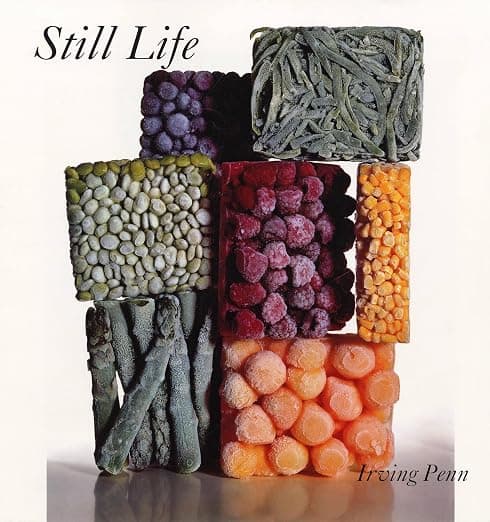 Still Life : Irving Penn Photographs, 1938-2000 | Still Life : Irving Penn Photographs, 1938-2000 | Irving Penn, John Szarkowski | 2001 | Bulfinch | His elegant and innovative photographs are the subject of this volume. It includes some 200 images. |
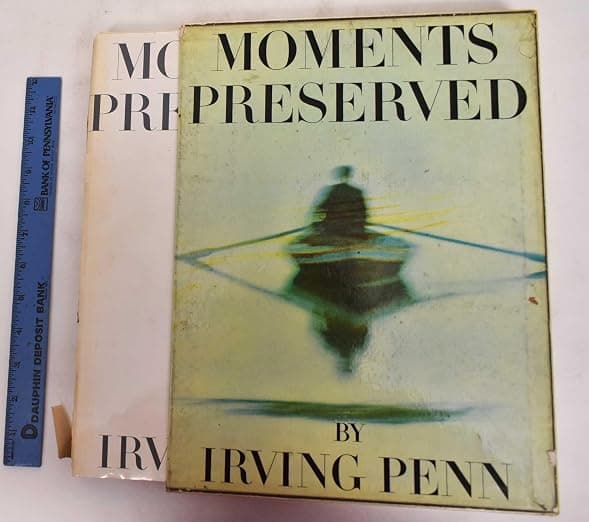 Moments Preserved* | Moments Preserved | Irving Penn | 1960 | Simon & Schuster | Early career-spanning monograph |
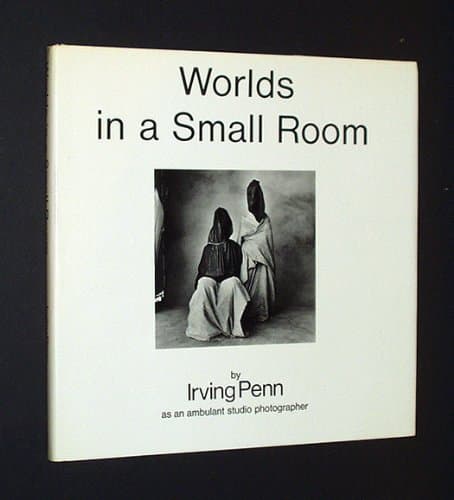 Worlds in a Small Room | Worlds in a Small Room | Irving Penn | 1974 | Grossman/Viking | Defines the portable-studio ethnographic project |
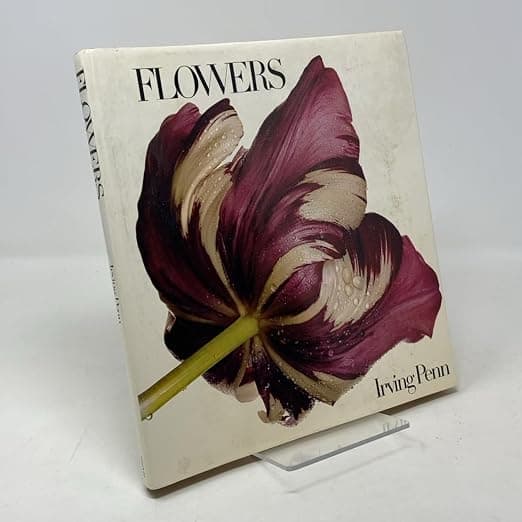 Flowers | Flowers | Irving Penn | 1980 | Harmony Books | Collects the Vogue flower still lifes |
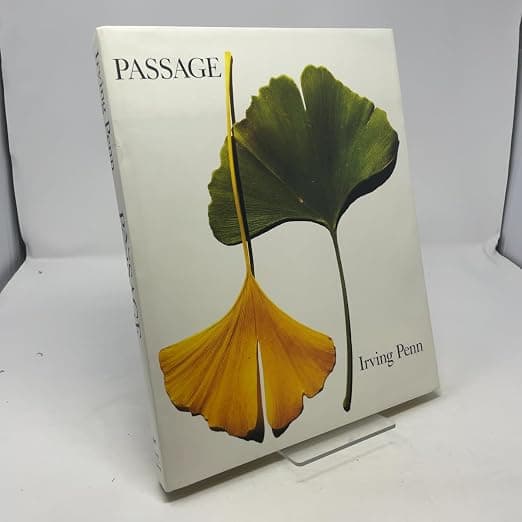 Passage: A Work Record | Passage: A Work Record | Irving Penn | 1991 | Knopf/Callaway | Career retrospective compiled by the artist |
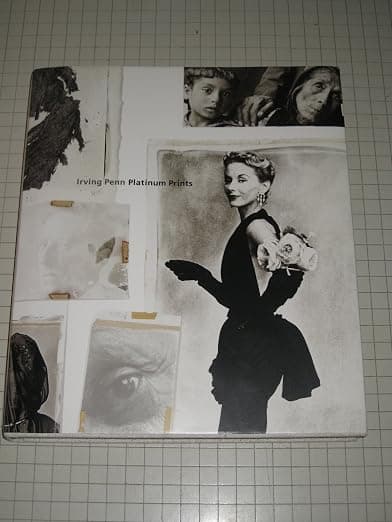 Irving Penn: Platinum Prints | Irving Penn: Platinum Prints | Irving Penn, Sarah Greenough | 2005 | Yale University Press | Showcases the exquisite platinum/palladium prints of Irving Penn |
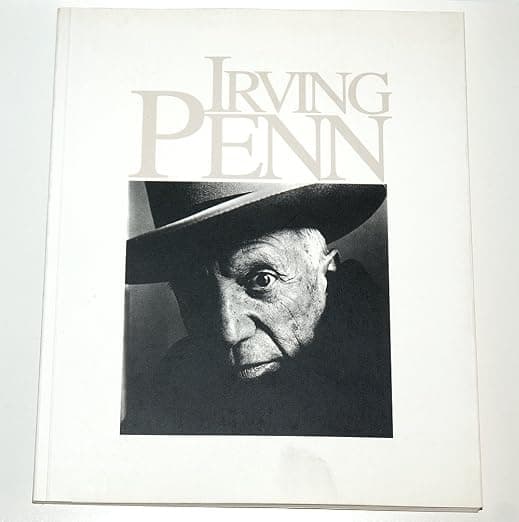 Irving Penn | Irving Penn | Irving Penn | 1998 | Bulfinch Press |
Books about Irving Penn
| Book | Title | Author/editor | Year | Publisher | Focus |
|---|---|---|---|---|---|
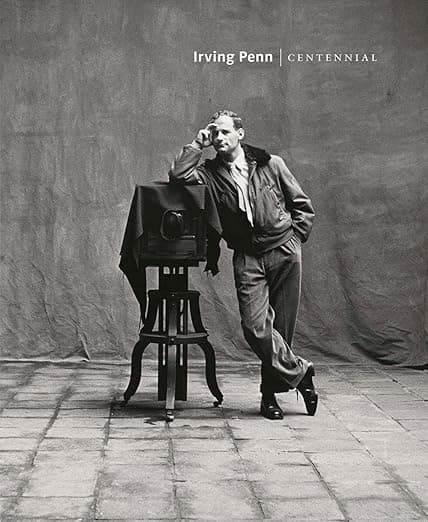 Irving Penn: Centennial | Irving Penn: Centennial | Maria Morris Hambourg, Jeff L. Rosenheim | 2017 | Metropolitan Museum of Art/Yale University Press | Features one of the largest selections of Penn’s photographs ever compiled |
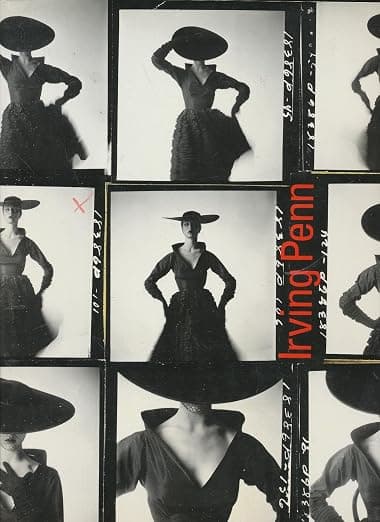 Irving Penn: A Career in Photography | Irving Penn: A Career in Photography | Colin Westerbeck, Colin Eisler, Issey Miyake, Edmund Carpenter | 1997 | Bulfinch | This retrospective showcases 90 images covering the whole of his career. |
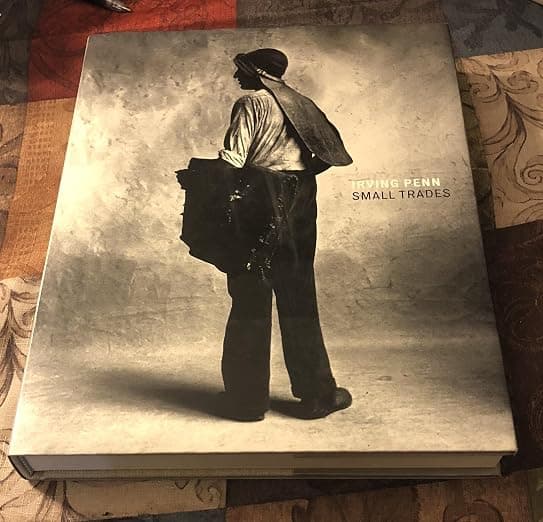 Irving Penn: Small Trades | Irving Penn: Small Trades | Virginia Heckert, Anne Lacoste | 2009 | Two hundred-six unique images from the series are flawlessly reproduced in this book | |
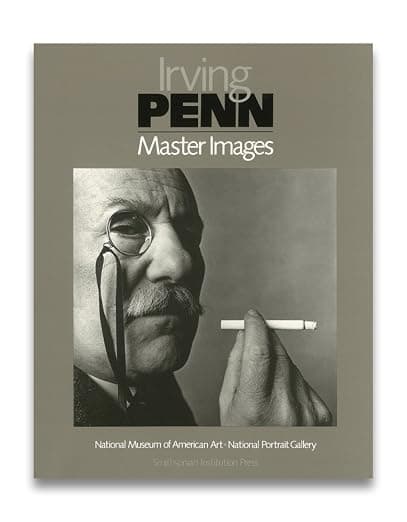 # Irving Penn: Master Images | Irving Penn: Master Images | Merry A. Foresta, William F. Stapp | 1994 | Smithsonian Institution Press | The Collection of the National Museum of American Art and the National Portrait Gallery |
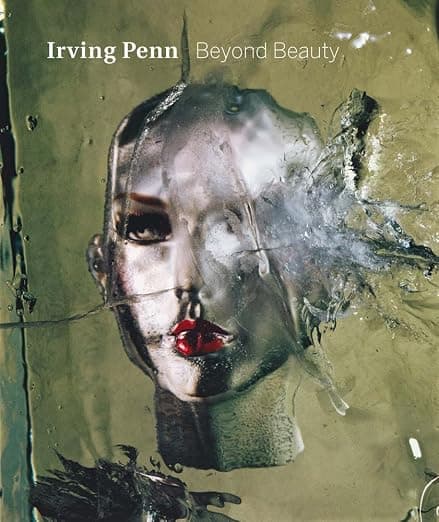 Irving Penn: Beyond Beauty | Irving Penn: Beyond Beauty | Merry A. Foresta | 2015 | Smithsonian American Art Museum | Accompanies the first retrospective exhibition of Penn’s work in nearly 20 years and features photographs from all stages of his career |
Films
| Film title | Year | Director | Duration | Relevance | |
|---|---|---|---|---|---|
| Who is Irving Penn? | 20 min | ||||
| *Irving Penn: Master of Minimalism * | SanalSergi, Photography History Podcast | 18 min | Explore the life, work and visual philosophy of Irving Penn | ||
| Curator talk on Irving Penn | 2024 | Emma Acker, Fine Arts Museums of San Francisco | 1h 09 min | Emma Acker is curator of American art at the Fine Arts Museums of San Francisco, and the coordinating curator for Irving Penn. | |
| THE PORTRAITS OF IRVING PENN | 2016 | Ted Forbes, The Art of Photography | 17 min | ||
| CAPTURING SOULS: The CANDID Portraits of IRVING PENN | 2023 | Joel Ulises | 41 min | The retrospective covers a diverse career spanning ethnographic photography, modern still lifes, and pioneering platinum printing methods. | |
| Irving Penn at the Intersection of Art, Fashion and Photography Forum | 2015 | Nancy Hall-Duncan, independent author and curator | 1h 15 min | Irving Penn: A New Language for Fashion Photography | |
| Irving Penn - Many Versions of Perfect | 2017 | B&H Photography Podcast | 43 min |
Sources
Official website, estate, or archive
Museums, galleries, and archives
- Metropolitan Museum of Art — Irving Penn: Centennial
- Metropolitan Museum of Art — Irving Penn: Small Trades
- Museum of Modern Art — Irving Penn
- J. Paul Getty Museum — Irving Penn