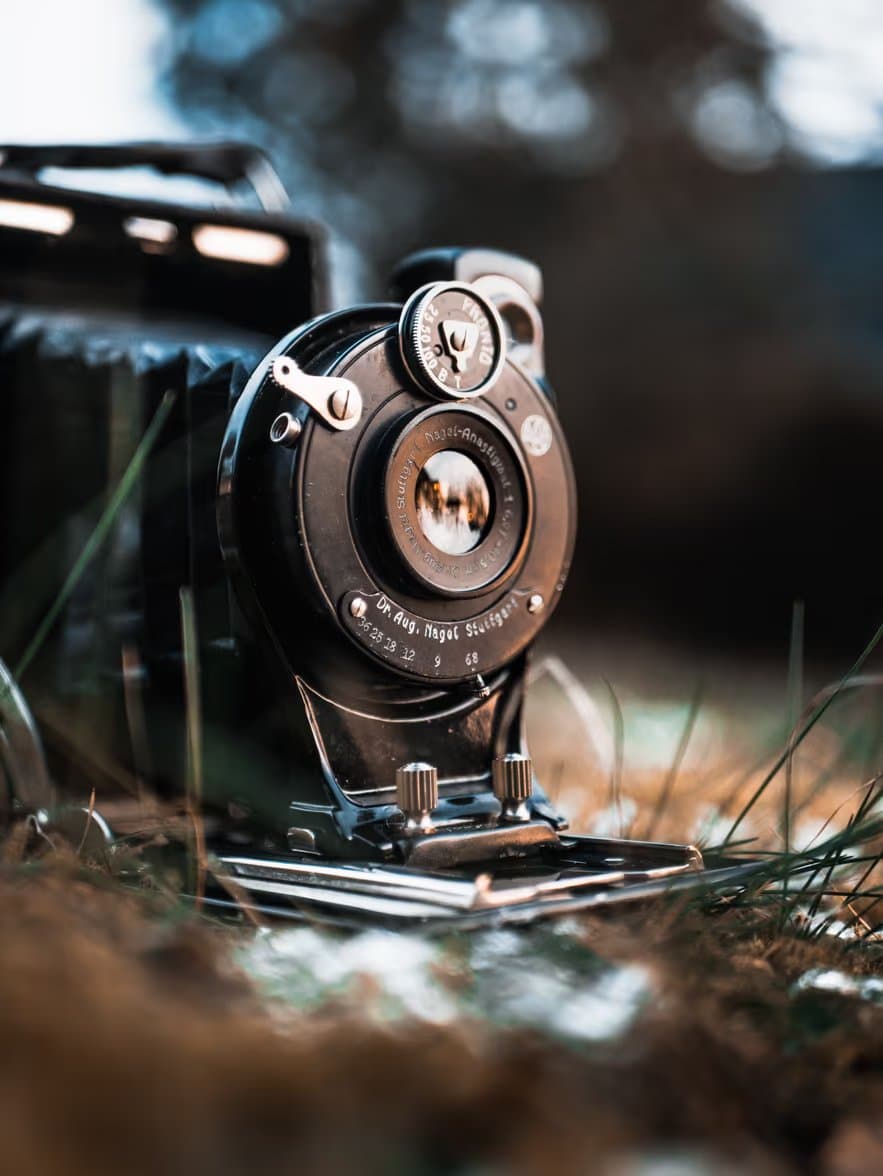
Painting with Light: The History of Photography from Niépce to Neural Networks
9/27/2026
For almost two centuries photography has argued with itself — art or craft, evidence or manipulation. A long-form overview for anyone who picks up a camera.
Drawing with Light: A History of Photography from Niépce to Neural Networks
For almost two centuries photography has argued with itself: is it art or craft, evidence or manipulation, memory or its forgery? We walked the whole of that history — from an eight-hour exposure at Le Gras to images nobody ever took — to find out what in it still matters to anyone who picks up a camera today.
The word "photography" literally means "drawing with light." That definition already contains the medium's central conflict: does the light do the drawing by itself, mechanically, or does the person who decides where to point it? The answer has changed every twenty or thirty years, and each new answer has produced a new movement. What follows is a short map of those turns.
Before photography, and the first experiments (1820s–1840s)
Long before photography existed, artists and scientists were working with light: the camera obscura projected an image onto a surface, and all that remained was to learn how to hold it there. Joseph Nicéphore Niépce was the first to manage it. His "View from the Window at Le Gras" (1826–1827) needed an exposure of around eight hours, but it became the world's first fixed photographic image.
 "View from the Window at Le Gras", Niépce, 1826
From there the story splits into two paths that, in a sense, are still arguing with each other.
The daguerreotype (1839). Louis Daguerre introduced a process that produced a unique, astonishingly sharp image on a silvered copper plate. The daguerreotype had a mirror-like surface, exposures measured in minutes, a high price, and great fragility — and, above all, it could not be reproduced. Each picture existed in a single copy.
 Louis Daguerre
The calotype (1841). William Henry Fox Talbot went another way: a paper negative from which any number of positive prints could be made. The image was softer and less detailed, but cheaper and repeatable. That logic — one negative, many prints — became the foundation of all twentieth-century photography.
 Calotype: Negative |  Calotype: Positive |
Craft, trade, and "foreign lands" (1840s–1860s)
The first thing photography did was democratize the portrait. Studios opened across Europe and America; a picture of oneself, previously available only to those who could commission a painting, became a mass commodity. Tiny cartes-de-visite — portraits the size of a calling card — turned into a social game: people exchanged and collected them.
At the same time the camera became an instrument of knowledge. Photographers documented ancient ruins, urban architecture, botanical specimens. And they travelled: the pyramids of Egypt, the temples of India, the streets of Japan. These pictures shaped how Europeans imagined "foreign" lands long before mass tourism reached them.
 "Cartes-de-visite" |  "The Cowgate arch of George IV Bridge, Edinburgh", William Donaldson Clark, 1860 |  "Japanese Woman in Carriage", Suzuki Shin'ichi, 1870s |
In the Russian Empire the first permanent studios opened in St Petersburg and Moscow in the 1840s; by the 1850s the network had reached provincial towns, and in the 1860s–1880s itinerant photographers with travelling studios roamed the vast country, going where a fixed studio made no economic sense. By the end of the century, with the arrival of Kodak cameras, photography had finally become an amateur pursuit.
 Photo in Bessarabia
Art or craft?
The question arose almost as soon as the medium did. Commercial studios turned out crisp, technically flawless portraits. But as early as the 1860s Julia Margaret Cameron deliberately broke the rules of sharpness, shooting in soft focus and dramatic light and staging her scenes — producing emotional, almost mystical images that stood against the "mechanical" quality of the studio portrait. The argument about where craft ends and art begins started here, and it has never ended.
 "I wait", Julia Margaret Cameron, 1872 |  "Sir John F. W. Herschel", Julia Margaret Cameron, 1867 |
The camera goes to war (1850s–1880s)
As soon as mobile darkrooms existed, the camera reached the battlefield. Roger Fenton photographed the Crimean War (1853–1856); Mathew Brady and Alexander Gardner covered the American Civil War (1861–1865). But these images were not "pure truth": scenes were often staged, bodies rearranged for composition, and censorship removed the worst of it. From the very beginning, war photography was not only testimony but also a tool of propaganda and narrative control.
 "A group of men from the 4th Light Dragoons being attended to", Roger Fenton, 1855
The colonial gaze — and its Russian version
Photographers working in India, North Africa, and the Middle East produced so-called "ethnographic" images: supposedly scientific documents recording the "types" and "customs" of colonized peoples. In reality they manufactured stereotypes. It helps to ask three questions of such pictures:
- What is shown? Usually a studio set-up: "natives" in traditional dress against a neutral background, stripped of context and individuality.
- What is hidden? The violence of colonization, people's real lives, their voices. The frame excludes everything that does not fit the narrative.
- For whom? For a European viewer consuming the exotic. The photograph served not the person in the frame but the gaze of the person behind the camera.
The same logic operated in the Russian Empire as it advanced into the Caucasus and Central Asia: ethnographic "types" in traditional clothing, studio staging, the illusion of objective scientific recording in the service of a distinctly imperial point of view.
 "The oriental races and tribes, residents and visitors of Bombay", 1860s |  "Shamil", Denyer, 1859 |
Sergei Prokudin-Gorsky (1863–1944), a pioneer of colour photography, stands somewhat apart. He made three separate exposures through red, green, and blue filters and travelled the country in a specially fitted railway carriage that served as a darkroom. Between 1909 and 1915, with the backing of Nicholas II, he produced a systematic colour survey of the empire — more than ten thousand images of its territories, peoples, and monuments. It is at once a priceless document and part of the same imperial project of visual conquest.
 Lev Toslstoi, 1908 |  Peasant girls. [Russian Empire], 1909 |  Emir of Bukhara. Bukhara, 1911 |
Pictorialism, and the reply to it: straight photography
At the turn of the twentieth century photography made its first serious attempt to enter the gallery — by pretending to be painting. The pictorialists (Alfred Stieglitz, Clarence White) worked in soft focus, pursued atmosphere and emotional effect, and manipulated their prints by hand to heighten the "painterly" quality. Their work rivalled Impressionism for mood.
 "Girl with a mirror", Getrude Käsebier, 1910 |  "Dream", Imogen Cunningham, 1910 |  "Waterloo Place", Leonard Misonne, 1899 |
The reaction came quickly. Paul Strand and Edward Weston rejected painterly conventions and celebrated what only a camera can do: optical precision, sharp focus, rigorous formal composition. Group f/64 — Ansel Adams, Imogen Cunningham, Weston — turned this into a manifesto: the medium should not imitate other arts; its beauty lies in its own ability to see the world with unprecedented clarity.
 "Shells", Edward Weston, 1927 |  Dunes, Brett Weston, 1946 |  Magnolia Blossom, Imogen Cunningham, 1925 |
 "Clearing Winter Storm, Yosemite National Park, California", Ansel Adams, 1937
Photo-surrealism: the impossible that looks real
After the First World War the surrealists — Breton, Dalí, Magritte — sought an escape from rational bourgeois reality into the world of dreams and the unconscious. Photography turned out to be the ideal tool: the camera and the darkroom made the impossible tangible, turning fantasy into a convincing "document" — and far faster than painting could.
The key figures: Man Ray (rayographs, solarization, multiple exposure), Maurice Tabard (photomontage, rotations, disorienting compositions), Dora Maar (collage, strange objects, psychological portraits), Hans Bellmer (the body, desire, the unconscious).
 "Tête du Mannequin d'Andre Masson", Raoul Ubac, 1937 |  "Bois des îles", Nusch Éluard, 1937 |  "Hanel 1", Pierre Molinier, 1967 |
The classic surrealist toolkit: double and multiple exposure, combination printing and montage, cameraless photograms, solarization, distortions and unusual angles, deliberate darkroom "damage" — scratches, burning, chemical accidents. Today it includes heavy Photoshop compositing (Erik Johansson), hybrids of 3D and photography, and images augmented by neural networks.
 "La Poupée", Hans Bellmer, 1934 |  "Le Violon d'Ingres", Man Ray, 1924 |  " Jacqueline Goddard", Man Ray, 1932 |
But technique is not the point. Real photo-surrealism is born where convincing photographic detail meets a logically absurd scene. Its markers: unexpected juxtapositions of objects that never meet in reality; "displaced reality" — an ordinary scene with one critically altered element (gravity, scale, time, anatomy); the absence of a clear story combined with a powerful emotional charge; and the tension between plausible detail and an impossible whole. That contrast is what makes the magic.
The Soviet avant-garde: a revolution in visual language
In the 1920s Alexander Rodchenko and Gustav Klutsis created a radically new language: dynamic angles, diagonal compositions, layered photomontage, text embedded directly in the image. The constructivists believed art should serve the revolution and shape a new mass consciousness — and they turned photography into an instrument of agitation and design.
 "Fire Escape", Aleksandr Rodcenko, 1925 |  "Girl with a Leica", Aleksandr Rodcenko, 1932 |  "Pioneer with a Trumpet", Aleksandr Rodcenko, 1930 |
The paradox is that their radical viewpoints — from above, from below, on the diagonal — have become commonplace: every drone shot, every wide-angle architectural frame is a direct descendant of the "new vision." What broke perception in the 1920s now sits in everyone's pocket.
35 mm, Robert Capa, and the birth of Magnum
The compact 35 mm Leica changed the nature of reportage. Robert Capa, who covered the Spanish Civil War and the Second World War, had unprecedented mobility and brought viewers a closeness to combat that had not been possible before. His maxim became the manifesto of a generation:
"If your pictures aren't good enough, you're not close enough." - Robert Capa
His frames from the Normandy landings of 6 June 1944 are the symbol of being present. Of 106 frames shot on Omaha Beach under fire, only eleven survived: most of the negatives were ruined in a London lab where an assistant, in a rush, over-dried the film. But the blur and grain of the surviving pictures became the very embodiment of chaos, fear, and courage.
 "The Falling Soldier", Robert Capa, 1936 |  "US troops assault Omaha Beach during the D-Day landings (first assault). Normandy", Robert Capa 1944 |
In 1947 Capa, Henri Cartier-Bresson, David "Chim" Seymour, George Rodger, and William Vandivert founded the Magnum agency. Together with the documentary work of the 1930s–1950s it cemented the humanist tradition and its ethical standard: empathy for the person in the frame, presence at the critical moment for the sake of historical truth, a search for shared human experience across borders.
 "„First Child (Miriam Trito) born in the settlement of Alma, Israel”, David "Chim" Seymour, 1951 |  "Couple kissing, Boulevard Diderot, Paris.", Henri Cartier-Bresson, 1961 |  "Gypsy Boys Playing Music", William Vandivert |
The flowering of documentary: the FSA, Life, and the photo essay
The Great Depression produced a new mission: to document social conditions in order to inform and prompt action. The Farm Security Administration (FSA) hired photographers — Dorothea Lange, Walker Evans, and others — to build a visual archive of American poverty and resilience. Their principle was dignity without sensationalism.
"The camera is an instrument that teaches people how to see without a camera." — Dorothea Lange
After the war came a new form: the photo essay, a multi-page visual narrative in magazines such as Life and Picture Post. W. Eugene Smith ("Country Doctor") and his colleagues turned individual pictures into coherent stories — not only about the drama of war but about its aftermath: ruined cities, orphaned children, the scars of survivors. Thanks to 35 mm cameras and print runs in the millions, this was the shift from distant official images to an immersive, personal experience.
 |  |  |
 |  |  |  |
| "Country Doctor", W. Eugene Smith, 1948 |
Vietnam: the war in the living room
Vietnam was the first conflict broadcast directly into people's homes. Television and photography showed what the government could no longer control: wounded soldiers, burning villages, coffins. The war stopped being an abstraction.
Two frames changed the course of that story. In June 1972 Nick Ut photographed nine-year-old Kim Phúc running down a road after a napalm attack — "Napalm Girl" became a symbol of the senselessness of war. On 1 February 1968 Eddie Adams captured the chief of South Vietnam's national police executing a prisoner in a Saigon street; the picture shocked the world with its bluntness.
 "Napalm Girl", Nick Ut, 1972 |  "Saigon Execution", Eddie Adams, 1968 |
The shift was fundamental. The Second World War had produced heroic images of liberation and national unity; Vietnam produced doubt about official narratives and questions about the morality of war. Images no longer served propaganda — they became a weapon against it.
The 1960s: photography enters the museum
The postwar decades were a turning point: in the 1960s art photography was finally established in galleries and museums as a full form of contemporary art. New York's Museum of Modern Art played the key role. Prints began to be collected alongside painting and sculpture; an art market and new career paths took shape.
Meanwhile photographers themselves turned to the ordinary and abandoned idealization. Three figures defined the era:
-
Diane Arbus (1923–1971) — portraits of people on the margins of society: circus performers, transgender people, people with developmental disabilities. The square format of a medium-format camera, a direct gaze without judgement, exposing both vulnerability and dignity.
-
Lee Friedlander (b. 1934) — the city as a visual puzzle: reflections in shop windows, shadows, signs, fragments of architecture. He often included his own shadow in the frame, underlining the photographer's presence and the subjectivity of the documentary gaze.
-
Garry Winogrand (1928–1984) — the energy of the American street, chance gestures, unexpected juxtapositions. Thousands of intuitive frames whose apparent randomness conceals precise social observation.
 "A young man in curlers at home", Diane Arbus, 1966 |  "New York City", Lee Friedlander, 1963 |  "New York", Garry Winogrand, 1962 |
What united them was an aesthetic of awkwardness: a refusal to heroize, ambivalence (the work attracted and repelled at once), and a visual density that demanded active reading.
In the USSR, despite ideological pressure, a rich tradition of its own existed: photojournalists at newspapers and magazines balanced censorship against a drive for truth, and the many pictures of everyday life never intended for publication now give a more honest picture of Soviet reality than the official record.
 „It's not my dog business”, Vladimir Bogdanov, 1965 |  "Bread was brought", Grigori Dubinsky, 1960 |  "Birth of a Man", Sergei Vasiliev, 1970 |
 "Hairdressing Competition", Igor Gavrilov, 1977 |  "Fathers", Vsevolod Tarasevich, 1968 |
Colour becomes art
Until the late 1960s only black-and-white photography was taken seriously; colour was seen as commercial, frivolous, distracting. William Eggleston (b. 1939) broke that assumption. He photographed the banal objects of the American South — parked cars, gas stations, modest interiors — and printed them by the dye-transfer process, producing saturated, almost surreal colour. His method — elevating the ordinary through an attentive eye and compositional mastery — proved the artistic worth of colour.
 "The Outlands", William Eggleston, 1972 |  "he Red Ceiling", William Eggleston, 1973 |
Conceptualism: the camera as an instrument of ideas
The conceptual art of the 1960s used the camera not to make beautiful objects but to document ideas, processes, and ephemeral actions. Photography became a means of conveying a concept rather than an end in itself — and that freed it from the obligation to be beautiful.
Ed Ruscha (b. 1937) published a series of revolutionary photobooks: "Twentysix Gasoline Stations" (1963), "Every Building on the Sunset Strip" (1966). Systematic documentation of the banal, without commentary or artistic pretension — photography as a conceptual gesture.
By the end of the 1960s photography had stopped being merely "an object on paper": it entered installations, books, sequences, and joined with text. The borders between photography, video, performance, sculpture, and painting blurred — artists chose the tool to fit the idea, not the category.
 "Beware the Heat” |  Rakicevic Nenad |  Adobe stock |
The Pictures Generation and the culture wars (1970s–1980s)
The next generation questioned the very idea of the original. In an age of mass image reproduction every picture is already a quotation, a link in an endless chain of earlier images.
- Cindy Sherman transformed herself into stereotypical heroines from B-movies, advertising, and fashion magazines, showing that "femininity" is not a natural quality but a social construct assembled from visual clichés.
- Sherrie Levine rephotographed the work of Walker Evans and posed a provocative question: who is the author — the one who first pressed the shutter, or the one who rethought the image in a new context?
- Richard Prince rephotographed advertisements, turning commercial imagery into conceptual art.
 "Untitled #225", Cindy Sherman, 1990 |  "President Profile", Sherrie Levine, 1979 |  "Untitled (cowboy)", Richard Prince, 1989 |
The strategies of the era: appropriation of images, staged scenes imitating cinematic and advertising codes, photography combined with aggressive text criticizing consumer culture.
In the late 1980s this art collided with politics: scandals over exhibitions by Robert Mapplethorpe and Andres Serrano (1989–1990) led to cuts in the budget of the US National Endowment for the Arts and a nationwide debate about the limits of artistic freedom and "obscenity." The culture wars permanently changed the relationship between artists and the state.
 "Ken Moody and Robert Sherman", Robert Mapplethorpe, 1984 |  "Bertha", Andres Serrano, 1990 |
In the same years Carrie Mae Weems, in her "Kitchen Table Series" (1990) — twenty black-and-white scenes at a kitchen table — showed how large social dramas play out in private space: relationships, motherhood, loneliness, race. Lorna Simpson combined fragmented, anonymized images of women's bodies with short phrases, creating visual riddles about how race and gender are constructed through the gaze and through language. "I want the viewer to ask questions about what they see, not receive ready answers," she said.
 |  |  |  |  |
"Kitchen Table Series", Carrie Mae Weems, 1990
The Pictures Generation's question now concerns everyone. In the age of Instagram and TikTok we all "appropriate" constantly: we copy poses, recreate popular shots, use the same filters. Every mirror selfie refers back to an endless line of earlier selfies. What makes a photograph truly "yours"? Perhaps the artists of the 1980s were right: the question matters less than it seems.
Witness and activism: AIDS and apartheid
In the 1980s and 1990s the camera became a weapon of activism in two parallel crises. David Wojnarowicz documented the AIDS epidemic in the United States, exposing government inaction and stigma and fusing personal trauma with political protest. Gisèle Wulfsohn photographed the intersection of AIDS and apartheid in South Africa, showing how racial inequality deepened the epidemic. Gideon Mendel made intimate portraits that restored humanity to the epidemic's victims under systemic discrimination. These were testimonies that could not be ignored.
 "Arthur Rimbaud in New York", David Wojnarowicz, 1979 |  "The Mohau Center", Gisèle Wulfsohn, 1990 |  "A Broken Landscape", Gideon Mendel, 1979 |
The digital age: from film to pixels
The milestones are familiar: around 2000, the first camera phones; the mid-2000s, digital overtakes film; 2007, the iPhone; the 2010s, the era of social media. Digital sensors made the image instant, endless, and almost free. That democratized photography — and raised new questions about its value and meaning.

YouCam Perfect , a popular mobile photo editing and beautification app with AI-powered features
The smartphone changed three things: the camera is always with you (photography became spontaneous and everyday), automation puts technically competent pictures within everyone's reach, and instant editing turns the phone into a pocket studio.
But the biggest change is not in the device but in the economy. In a world where more than three billion images are uploaded every day, photography no longer competes for a place on a wall or in a magazine — it competes for attention. You do not decide what you see: the algorithm chooses for you. An image is judged by its ability to hold the eye, and it vanishes into the feed within seconds, demanding constant production of the new. That changes the aesthetic: brightness, contrast, unusual angles, shock — all serve a single purpose: to make the thumb stop scrolling.
Artificial intelligence and the crisis of authenticity
In 2014–2016 generative adversarial networks (GANs) began producing blurry but recognizable images. By 2018–2020 StyleGAN could generate faces indistinguishable from real ones. In 2021–2022 diffusion models — DALL-E, Midjourney, Stable Diffusion — made image generation from text a mass phenomenon. Today photorealistic generation is built directly into smartphone cameras.
This forces us to redefine the term itself. Traditionally, a photograph is the recording of light reflected from real objects, through optics, onto a light-sensitive surface. AI produces images that look like photographs but record nothing — they simulate the photographic process. Perhaps "photography" is now any image that uses the visual language historically tied to photographic practice. The question is open: if a neural network produces an image of a non-existent place that cannot be told from a photograph — is that photography, or a new medium?
 |  |  |
 |  |
AI generated images"
There are three sides to this. AI can visualize what cannot be photographed — historical events, fantastic scenes, places that do not exist. It creates ethical dilemmas — deepfakes, fake news photographs, manipulation of public opinion. And it gives artists a new tool for ideas that traditional methods could not reach.
But the most important consequence is the crisis of authenticity. For most of its history photography held a special status as proof: "I saw it with my own eyes" became "I have a photograph." Today that status is collapsing. When any image can be generated or fabricated with frightening plausibility, photography can no longer serve as objective evidence of reality. Seeing is no longer believing.
Where your practice sits
All of this history resolves into a spectrum on which it is useful to locate yourself:
- Documentary — minimal intervention, recording reality "as it is."
- Reportage — telling stories through authentic moments.
- Commercial — creating idealized images to sell.
- Fine art — expressing concepts, emotions, and ideas through the visual.
- Experimental — exploring the limits of the medium and of perception.
Each approach has its own rules, values, and ethical boundaries. Knowing where you stand helps you make deliberate decisions — and keeps you from judging reportage by the rules of an art project, or an art project by the rules of reportage.
The eternal themes
Technology has changed — from wet collodion to the smartphone — but photography keeps returning to the same questions of human existence. These are the themes that run through every era.
Family. From Victorian daguerreotypes to Sally Mann's "Immediate Family" and Nicholas Nixon's "The Brown Sisters" photographed over more than forty years — family photography does not record events; it keeps the chronicle of our identity.
 "Immediate Family", Sally Mann, 1992
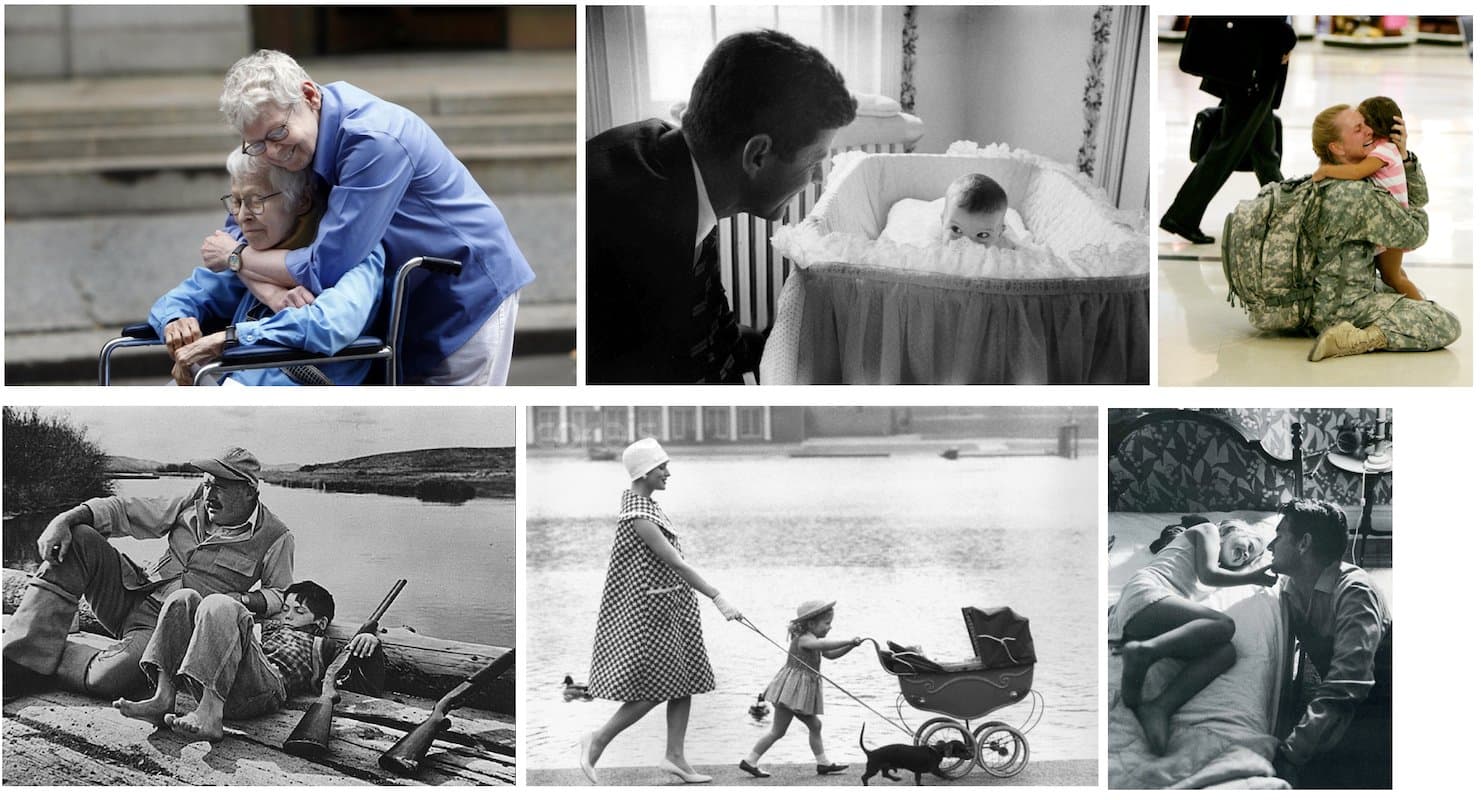
(1) "First same-sex couple to get married at the Manhattan City Clerk’s office", Jason DeCrow), 2011; (2) "Senator John F. Kennedy and daughter, Caroline", Ed Clark, 1958; (3) "Major Terri Gurrola hugs her daughter, little Gaby, upon returning from a military mission", Louie Favorite, 2007; (4) "Ernest Hemingway with his son Gregory", Robert Capa, 1941; (5) "Model Jane Trevor and Antonia Allusen (daughter of Lady Clare Rendlesham) on a walk with a dachshund", Norman Parkinson, 1959;
Love and relationships. Love shows itself in stolen glances, in hands, in the space between bodies. From Robert Doisneau to Nan Goldin, photographers have shown that love can be tender and cruel at once. Larry Sultan and Richard Billingham explored family relationships without avoiding discomfort: real intimacy lives in the tension between connection and separation.
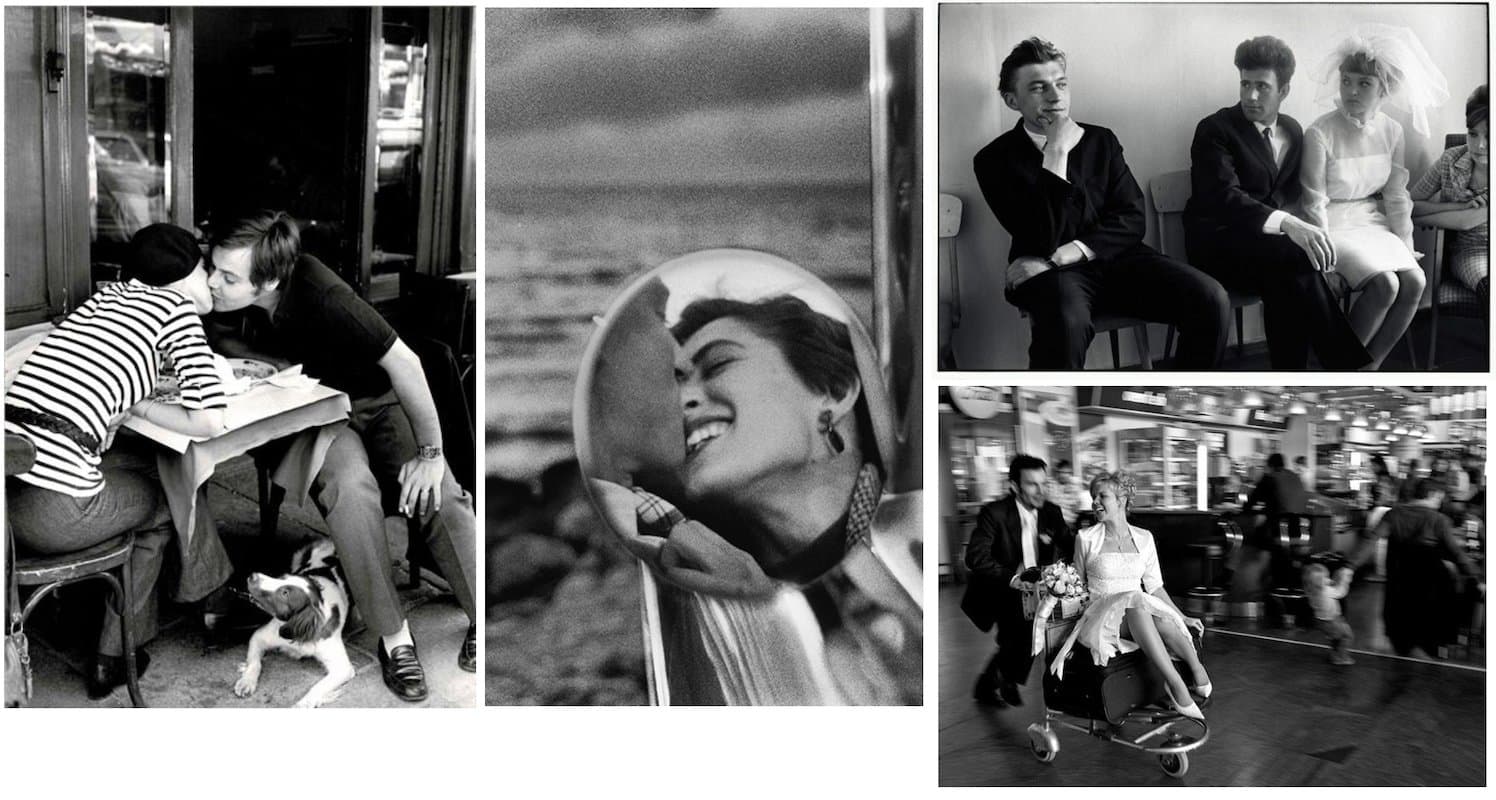
(1) „Couple Kissing, Boulevard Diderot, Paris”, Henri Cartier-Bresson, 1961; (2) „California Kiss”, Elliott Erwitt, 1955; (3) "Bratsk, Siberia, USSR", Elliott Erwitt, 1967
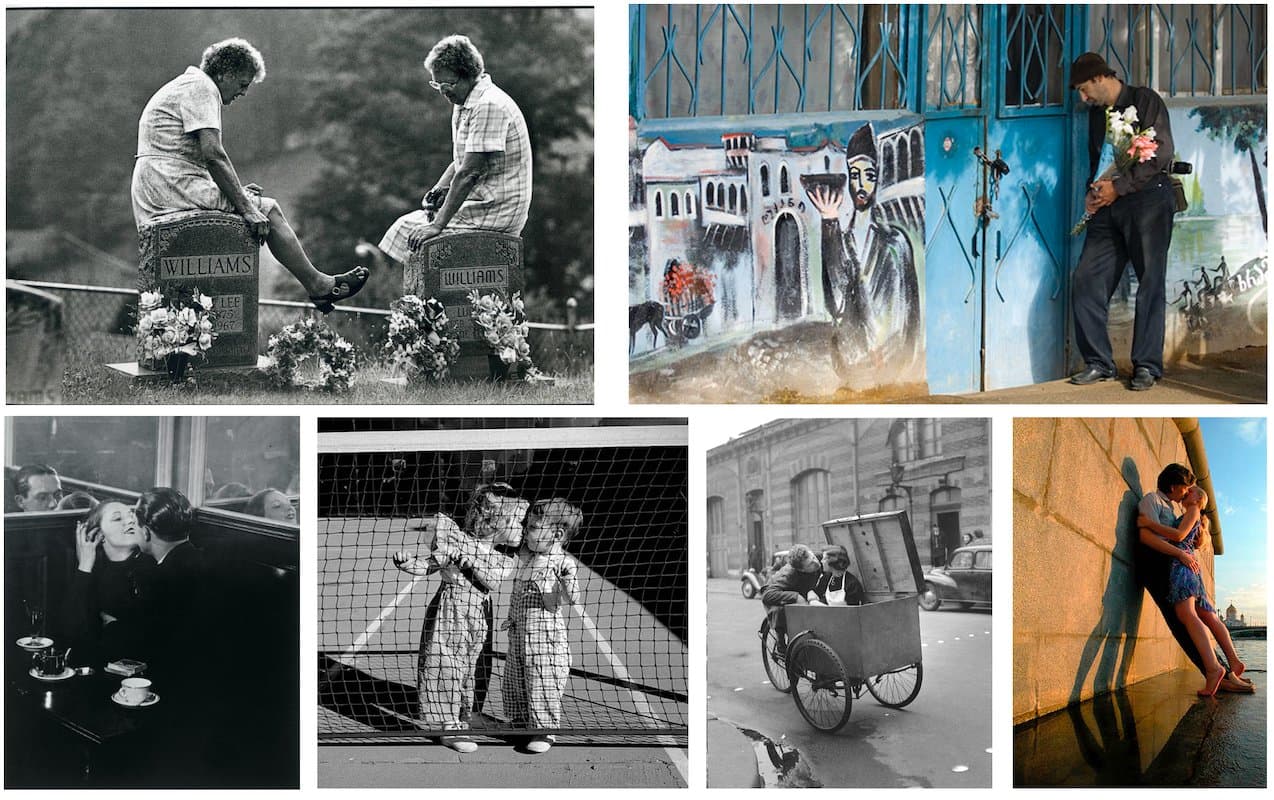
(1) "Women Visiting Family Graves", David Turnley, 1983; (2) Unknown; (3) „Couple d'amoureux dans un petit café, quartier Italie”, Brassaï, 1932; (4) "Los Angeles (Two Children Kissing at Tennis Net)", Vivian Maier, 1955; (5) "Le baiser blotto", Robert Doisneau, 1950; (6) "Moscow for Kisses", Georgy Rozov
Work.* From Lewis Hine, who exposed child labour, to Sebastião Salgado, who turned hard physical labour into epic narratives full of dignity — photography makes invisible work visible.
 Sebastio Salgado
Everyday life. Street photography — from Henri Cartier-Bresson to Vivian Maier — turns chance moments into revelations. Morning coffee, a metro ride, light in a window: the significant hides inside the insignificant.
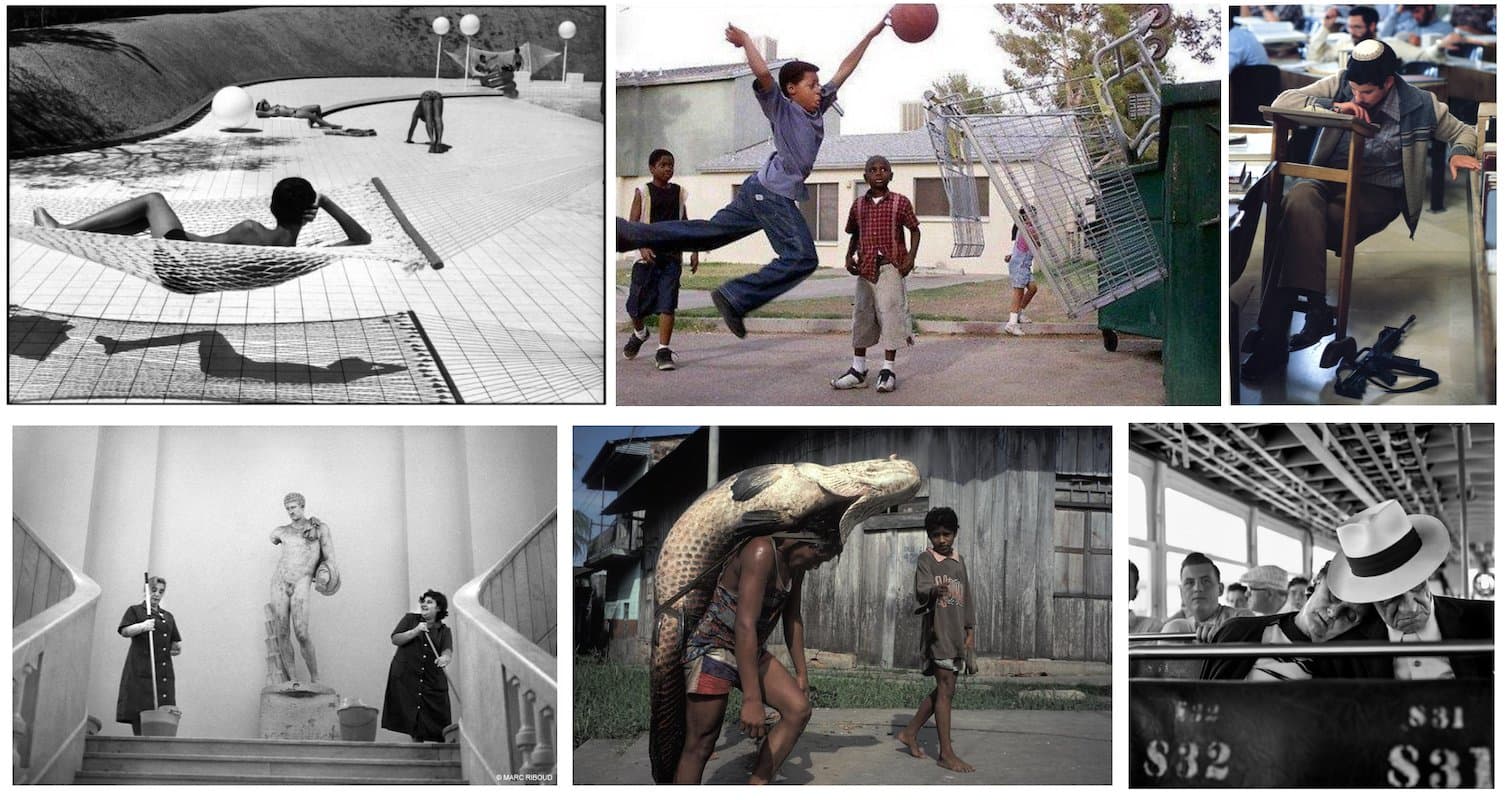
(1) "Swimming pool designed by Alain Capeillères, Le Brusc, Var, France", Martine Franck, 1976; (2) Andy Clark, 1990; (3) James Nachtwey, 1990; (4) „Which of the two matrons will seduce the beautiful Apollo”, Marc Riboud, 1988; (5) Alex Webb, 1993; (6) Vivian Maier, 1960
Power. Photography can be a tool of propaganda and control — and a means of resistance and exposure. James Nachtwey and Susan Meiselas make the consequences of political decisions visible. Always ask: who is photographing, who is pictured, and who controls the narrative.
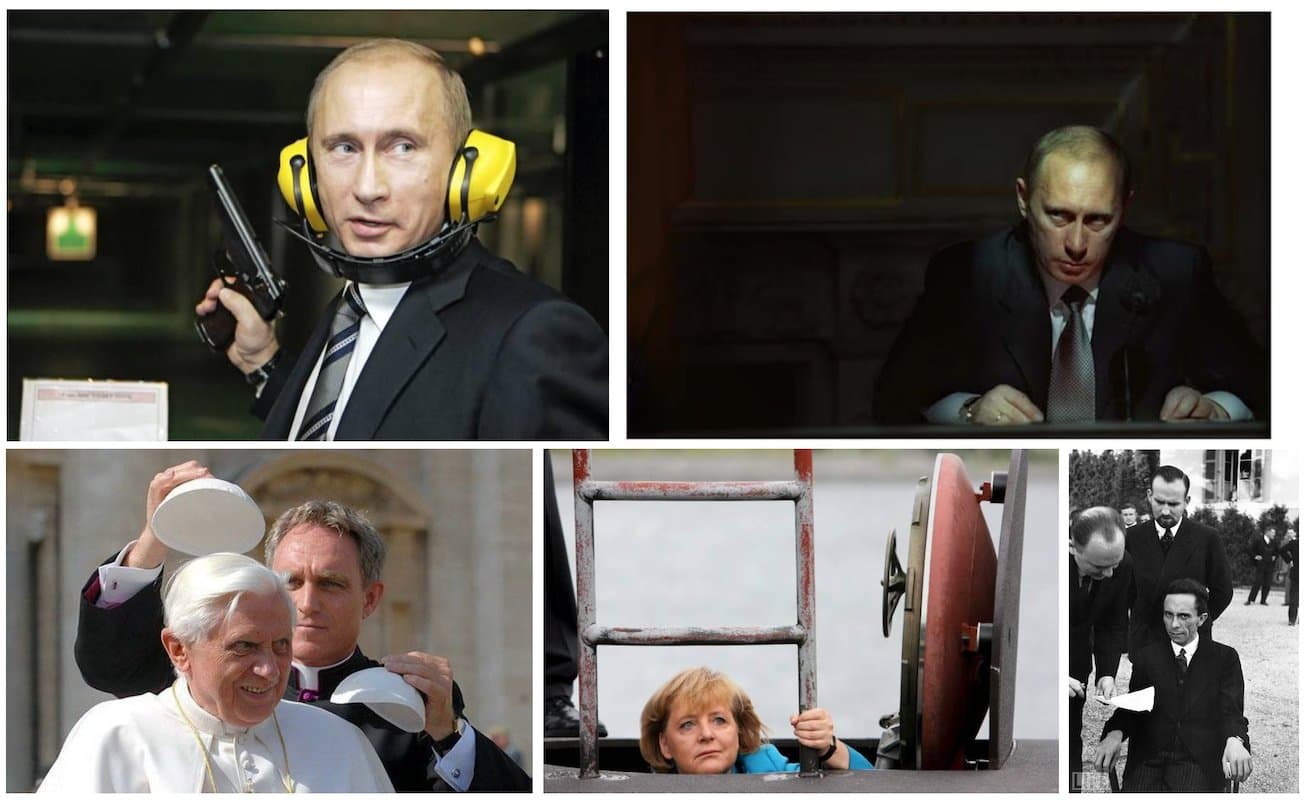
(1) "Russian President Vladimir Putin stands with a gun at a shooting gallery in Moscow", Dmitry Astakhov, 2006; (2) "Vladimir Putin", Sergey Maximishin, 2003; (3) ""Pope Benedict XVI receives a new solideo from his personal secretary, Georg Gänswein", Michael Kappeler; (4) "Germany's Chancellor Angela Merkel climbs down the ladder into the submarine U 33", Heribert Proepper; (5) "Eyes of Hate", Alfred Eisenstaedt, 1933
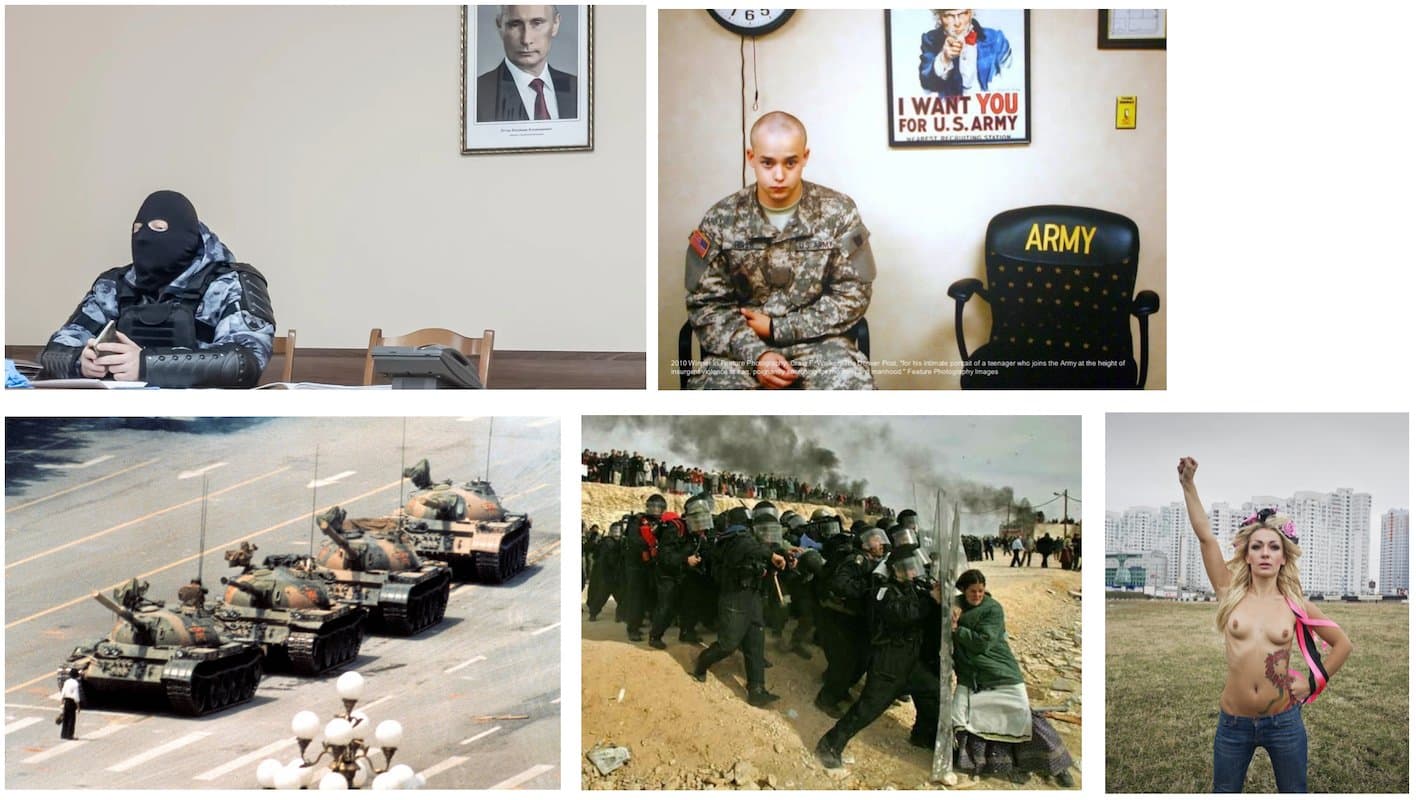
(1) "Riot police officer sitting under a portrait of President Vladimir Putin", Dmitri Markov, 2021; (2) "Ian Fisher: American Soldier", Craig F. Walker, 2010; (3) "Tank Man", Jeff Widener, 1989; (4) "Defending the Barricade", Oded Balilty, 2006; (5) "The New Amazons", Guillaume Herbaut, 2011
Conflict. Robert Capa, Don McCullin, Lynsey Addario risked their lives to show war. Their work raises questions without answers: do we have the right to photograph suffering? Can a picture change anything? "Napalm Girl" proved that it can.
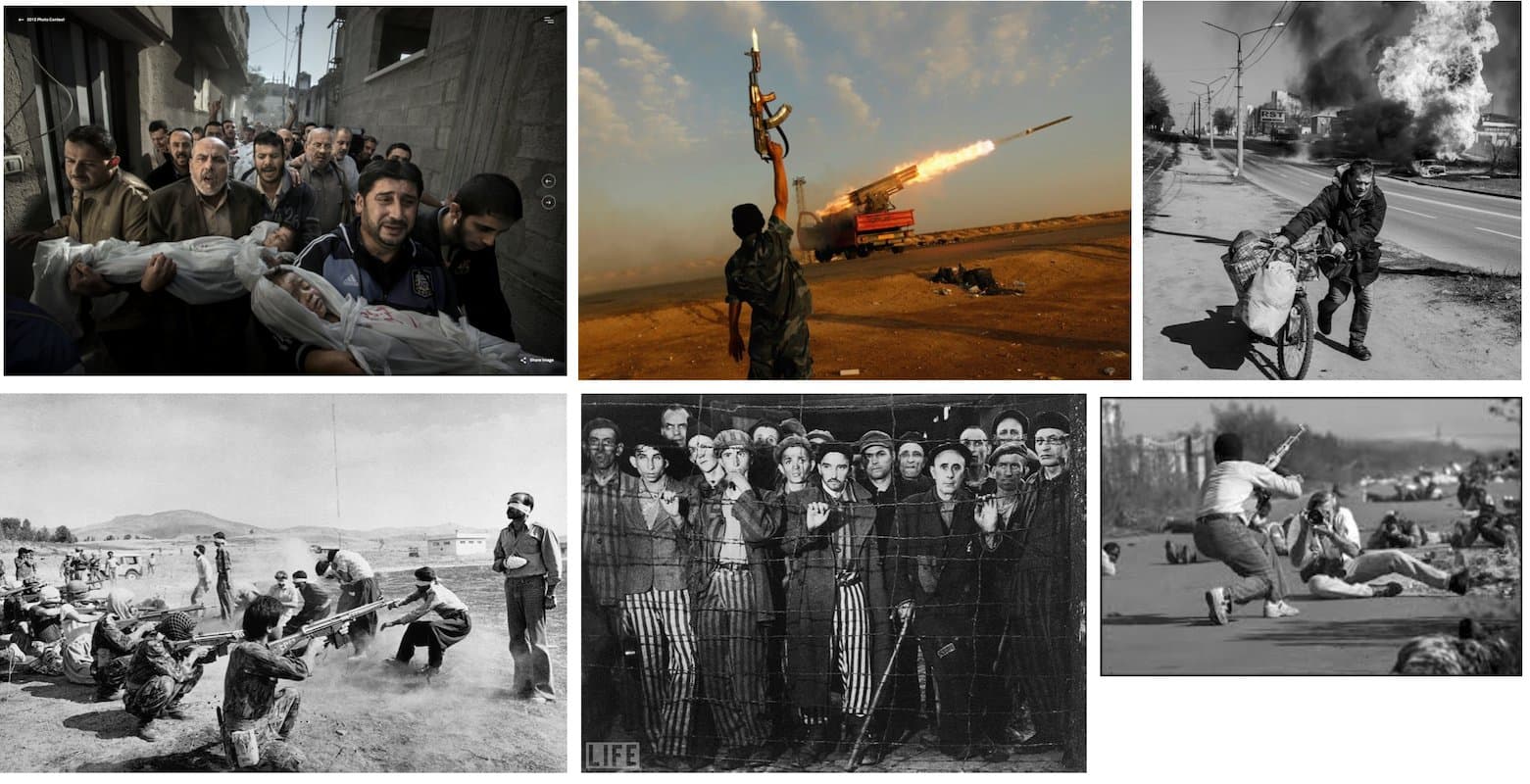
(1) "Gaza Burial", Paul Hansen, 2012; (2) "A rebel fighter celebrates as his comrades fire a rocket barrage toward the positions of troops loyal to Libyan ruler Muammar Gaddafi" Chris Hondros, 2011; (3) "The Cost of Russian Onslaught in Ukraine", James Nachtwey, 2022; (4) "Firing Squad in Iran", Jahangir Razmi, 1979; (5) "The living Dead of Buchenwald", Margaret Bourke-White, 1945; (6) War Photographer”, Christian Frei, 2001
Landscape. From the sublime romanticism of Ansel Adams to the critical eye of the New Topographics and on to Edward Burtynsky documenting the Anthropocene: quarries, landfills, industrial landscapes, beautiful and horrifying at once. Landscape has become a political statement.
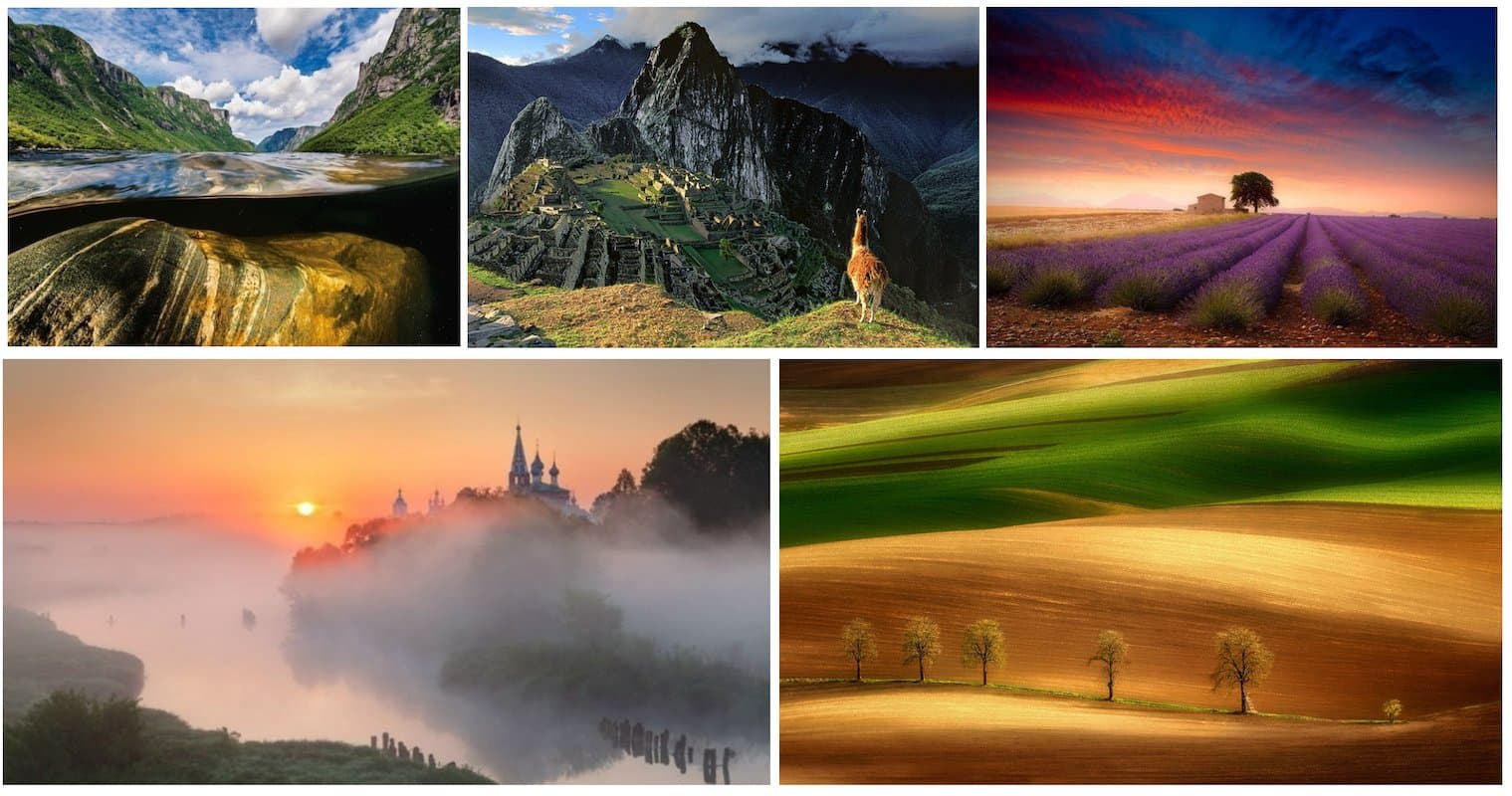
Landscapes
Home. A vessel of memory and belonging. Todd Hido's enigmatic lit windows in the suburbs — inviting and alienating at once. For refugees and migrants, a picture of home is an anchor in a sea of displacement.
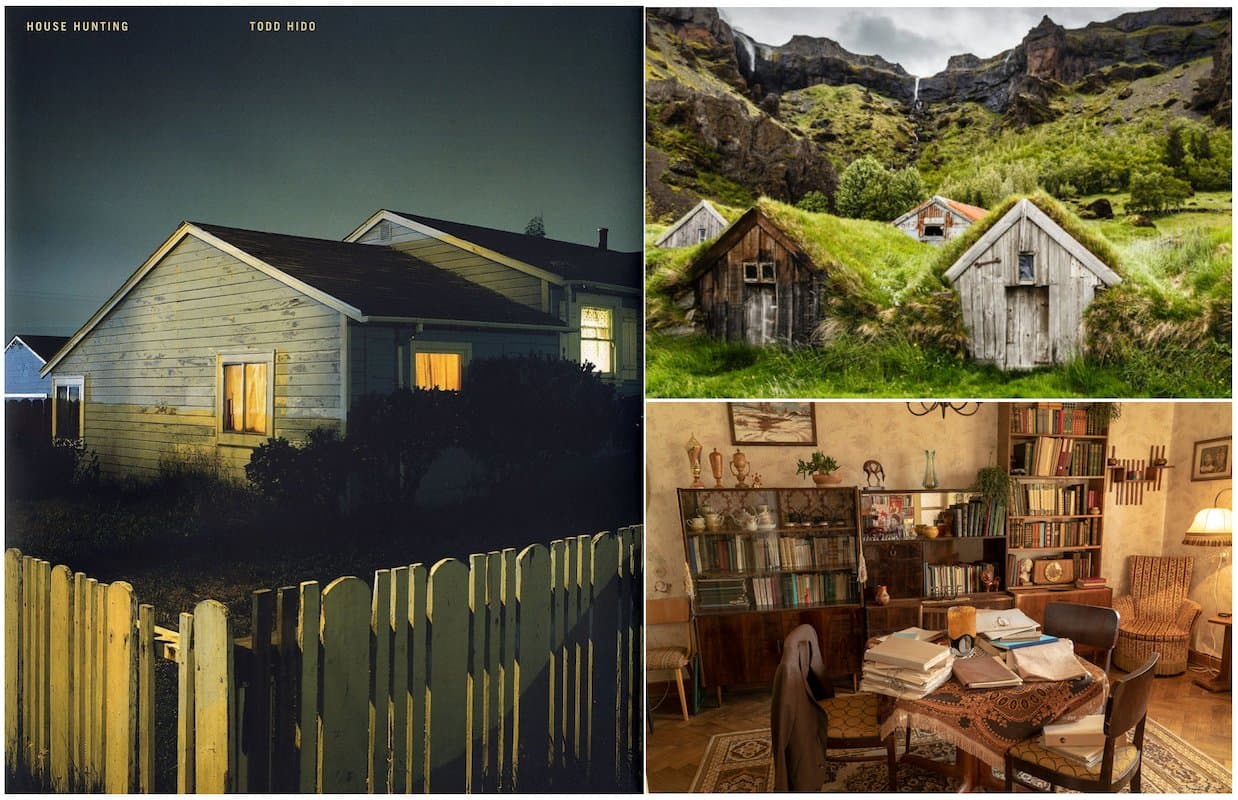
)1) "House Hunting”, Todd Hido; (2) "Torfbæir, Kálfafell village, Iceland", Todd Hido ; (3) "Appartment in Pripiat, Chernobyl", Jakob Ihre
Self-portrait. Francesca Woodman made ghostly images of her own body, exploring presence and disappearance; Nan Goldin documented her life with merciless honesty. In the age of the selfie the questions are the same: who is this person in the frame, what do they hide, and what do they reveal?
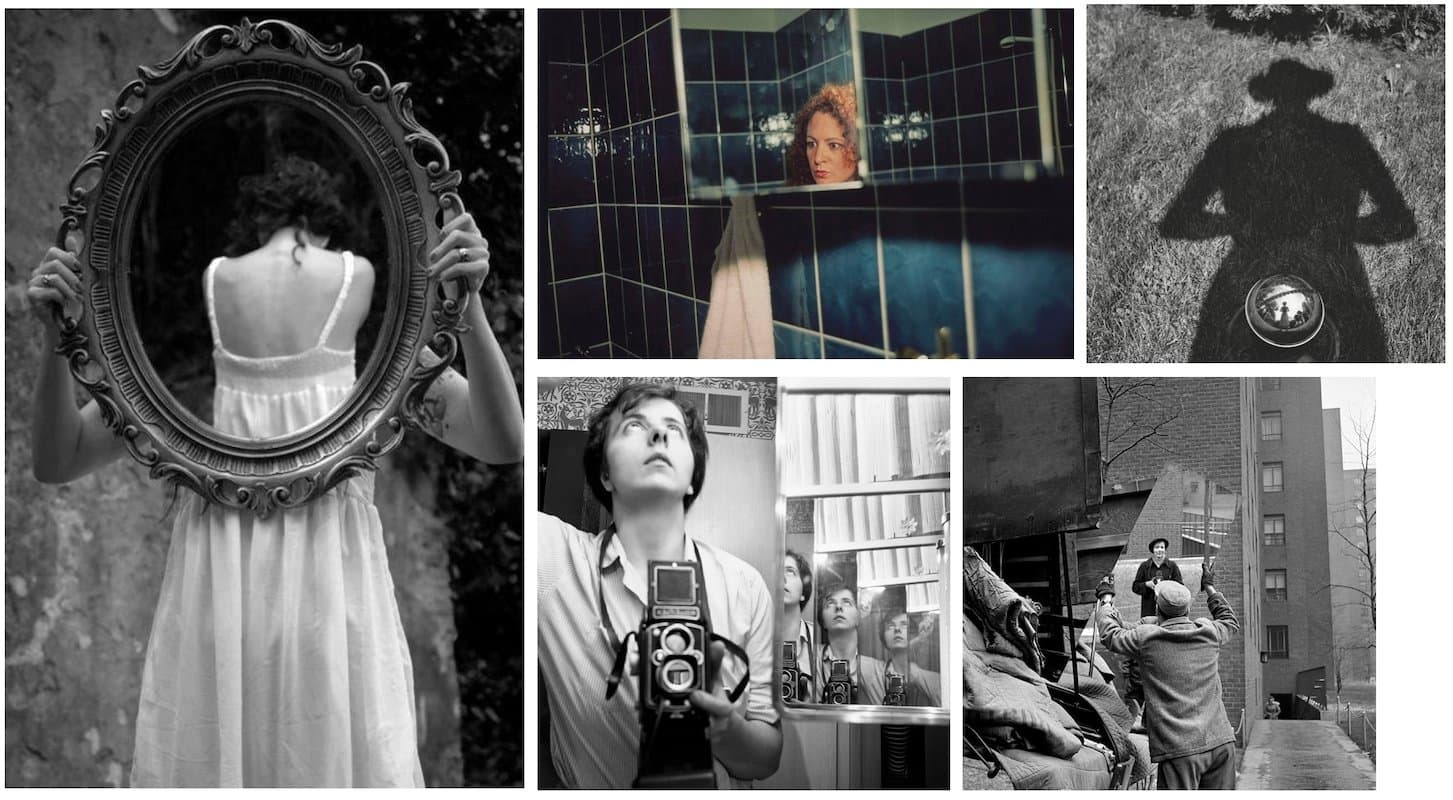
(1) "Untitled (Woman and Oval Mirror", Francesca Woodman, 1977 ; (2) "Self-portrait in my blue bathroom, Berlin”, Nan Goldin, 1991; (3) "Self-portrait", Vivian Maier; (4) "Self-portrait with Rolleiflex", Vivian Maier; (5) "Self-portrait, NYC, 1954", Vivian Maier;
Death. From the beginning photography has been bound up with death — from Victorian post-mortem portraits to projects about hospices. Roland Barthes wrote that every photograph says: "That has been." The ghost of the past is always in it.
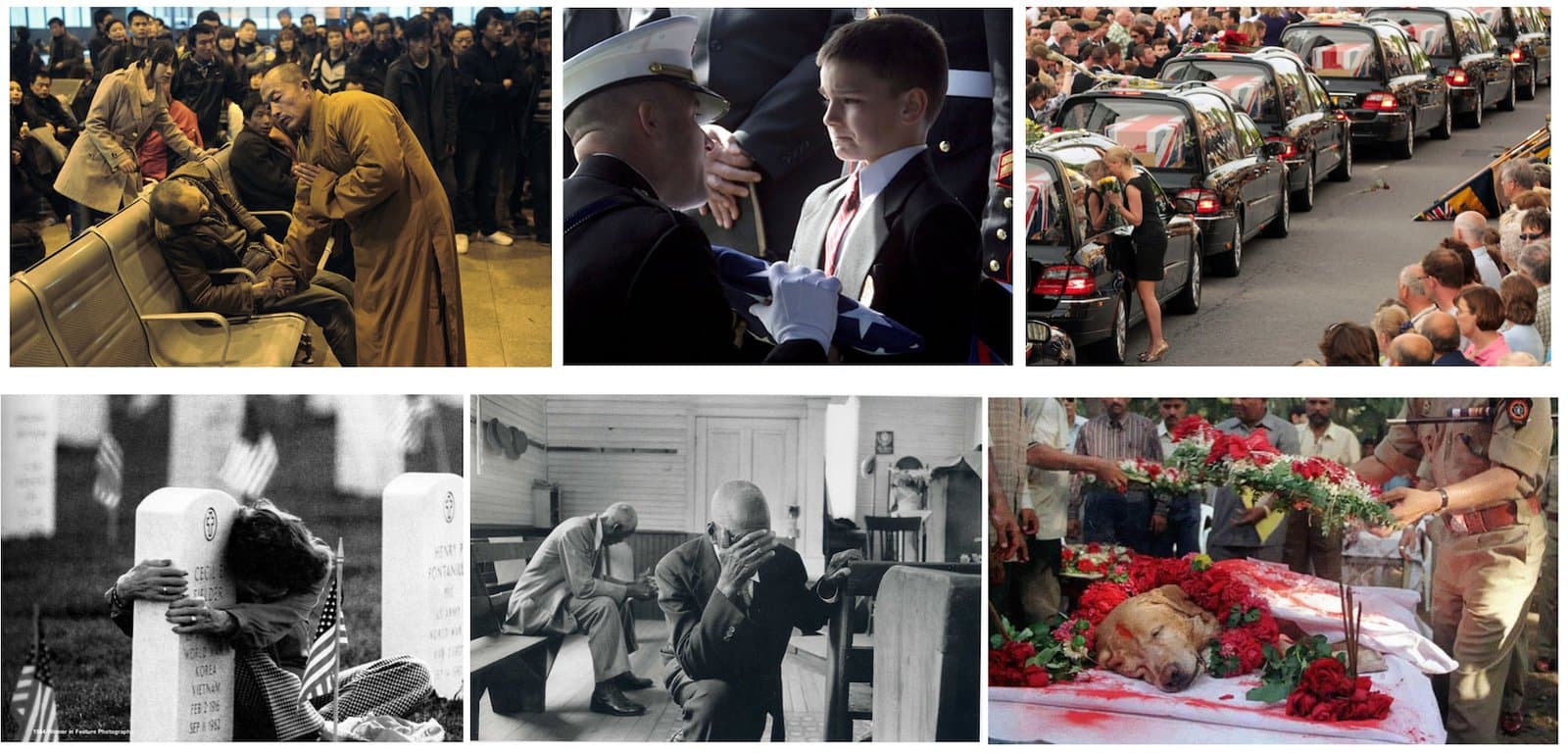
(1) "A monk prays for a dead man", Hu Yuanjia, 2011; (2) "Christian Golczynski receives American flag for father", Aaron Thompson, 2007; (3) "The Repatriation Of Seven Soldiers Killed In Afghanistan", Matt Cardy, 2010; (4) "Memorial Day", Anthony Suau, 1984; (5) "Men praying in church, Daufuskie Island, South Carolina", Constantine Manos, 1952;(6) "Funeral of Zanjeer, Mumbai's Hero Bomb Detection Dog", Stringer - name is not published for reasons of confidentiality or agency procedure
Memory and time. Photography is a technology of memory, but memory is unreliable: a picture can create false memories as easily as preserve real ones. It stops time and at the same time makes its passage visible — through faded colours, yellowed paper, through forty years of the Brown sisters.
 "The Brown Sisters", Nicholas Nixon
Why this matters
In a world of endless visual noise, returning to these themes is a return to the essence. Photography is not only technique and aesthetics; it is above all a human story that the medium has been telling for more than a century and a half, and every photographer finds their own voice in that conversation.
When you pick up a camera, you become part of a long tradition of people who asked fundamental questions about love, death, home, and time. Your eye is unique. The questions are eternal. That is both the power and the beauty of photography.